
Business
Retirees Face Unexpected Tax Burden as Dividends Soar

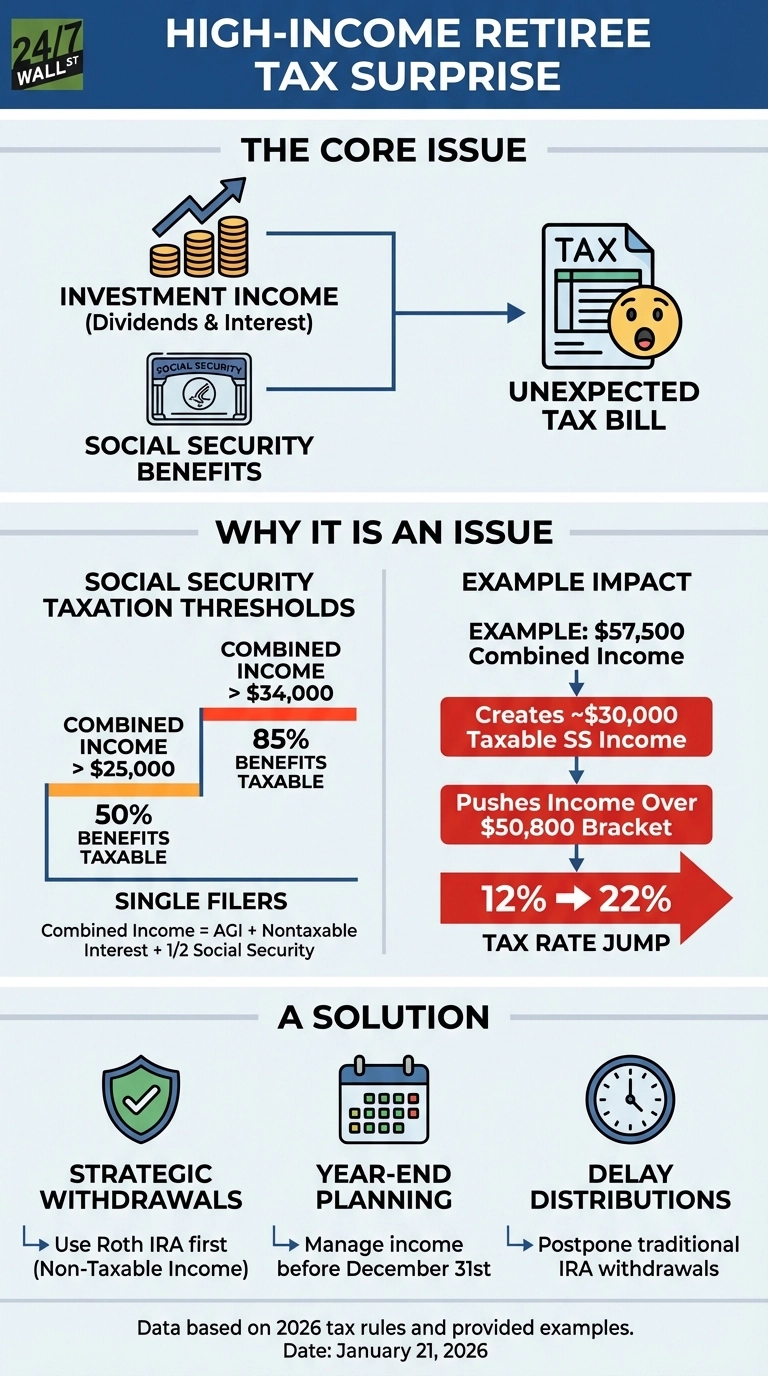
A recent analysis reveals that retirees relying on dividend income may face significant tax implications, particularly when combined with their Social Security benefits. For those who have built up a portfolio, the introduction of substantial dividend payments can unexpectedly shift their tax obligations, leaving many in a financial bind during tax season.
Understanding the Taxation of Combined Income
Retirees who hold investments in funds like the Schwab Dividend ETF (SCHD) and the Vanguard High Dividend ETF (VYM) can see annual dividends ranging between $20,000 and $30,000. When this income is added to a typical Social Security benefit of $35,000, it can create a combined income of around $30,000 that is subject to taxation. This substantial income can push individuals into higher tax brackets, specifically from the 12% to the 22% range, once they exceed the $50,800 threshold.
The core of the issue lies in how various income sources interact. Dividend income does not solely face its own tax rates; it also influences the taxation of Social Security benefits, triggering unexpected consequences for retirees. According to tax guidelines, Social Security benefits become taxable based on “combined income,” which consists of adjusted gross income, nontaxable interest, and half of the Social Security benefits themselves.
The Compounding Effect of Investment Income
For example, a retiree receiving $35,000 in Social Security and taking home $40,000 in dividends would see their combined income reach $57,500. This amount clearly surpasses the threshold where significant portions of Social Security become taxable. Consequently, approximately $30,000 of the benefits could be added to taxable income, a sum that would have otherwise been tax-free with lower portfolio withdrawals.
This situation exemplifies what is often termed “bracket creep,” where a retiree’s tax burden increases due to rising income levels. Currently, the tax brackets set for 2026 further complicate matters. As taxable Social Security benefits elevate total income beyond $50,800, any additional income falls into the higher 22% tax bracket, effectively doubling the tax rate on the last portion of income. This can transform a well-planned withdrawal strategy into an unexpectedly costly endeavor.
Though qualified dividends typically enjoy lower tax rates of 15%, the interaction between dividend income and Social Security taxation can lead to a situation where the apparent tax benefit on dividends results in a higher tax rate on Social Security benefits. Additionally, Medicare Part B premiums, which are based on earnings from two years prior, can also be affected by these income levels.
Strategies for Managing Tax Implications
To navigate these complex tax implications, retirees can consider several strategic approaches. One option is to prioritize withdrawals from a Roth IRA, as these distributions do not count as income and therefore do not affect Social Security taxation or Medicare premiums. Another strategy is to engage in year-end planning to manage income effectively before the calendar year concludes. Simple adjustments, such as delaying an IRA distribution, can help keep total income below the threshold that triggers taxation on Social Security benefits.
As tax season approaches, it is crucial for retirees to assess their combined income proactively. Even minor alterations to investment strategies can significantly impact tax liabilities. Once the year ends, any decisions made regarding income cannot be reversed, underscoring the importance of planning ahead.
For those looking to refine their financial strategies, tools like SmartAsset can connect users with vetted financial advisors who prioritize their clients’ best interests. This service offers retirees the opportunity to evaluate their retirement plans and ensure they remain on track to meet their financial goals.
In conclusion, understanding the interplay between different income sources and their tax implications is essential for retirees. By taking proactive steps and making informed decisions, individuals can alleviate some of the financial burdens associated with unexpected tax liabilities.

Philadelphia Parks Launch Free Earth Month Events Starting April 1

Bradford’s Fish Fry Fridays Serve Community with Delicious Dinners

Trump Faces Growing Challenges Amid Rising Tensions with Iran

Scientists Probe the Universe’s Missing Topological Defects

Samsung Galaxy Watch 9 to Feature Larger 435mAh Battery

UConn Huskies Aim to Defend Title in 2026 NCAA Women’s Tournament

U.S. Littoral Combat Ships Dock in Malaysia Amid Regional Tensions

Healthy Choice Wellness Reports Quarterly Earnings, Shares Rise

Urgent News: Charles M. Payment Passes Away at 78 in Duluth

University of Hawaiʻi Joins $25.6M AI Project to Enhance Disaster Monitoring

Major Grant Enhances Cancer Care and Research in Hawaiʻi

Joleen Chaney, Beloved Journalist, Passes Leaving Lasting Legacy

San Francisco’s SFO to Welcome 16 Airlines with Nonstop Flights to Europe in 2026

Goldman Sachs Unveils 2026 Catalyst Playbook for Biotech Investors

Discover Top Business Smartphones for Professionals in 2026

Urgent Update: Tom Aspinall’s Vision Deteriorates After UFC 321

Texas Roadhouse Honors Veterans with Free Meal Vouchers

CD Projekt Red Confirms No Release for The Witcher 4 in 2026
-
Science9 months ago
University of Hawaiʻi Joins $25.6M AI Project to Enhance Disaster Monitoring
-
 Health8 months ago
Major Grant Enhances Cancer Care and Research in Hawaiʻi
-
 Top Stories9 months ago
Joleen Chaney, Beloved Journalist, Passes Leaving Lasting Legacy
-
 World7 months ago
San Francisco’s SFO to Welcome 16 Airlines with Nonstop Flights to Europe in 2026
-
 Business8 months ago
Goldman Sachs Unveils 2026 Catalyst Playbook for Biotech Investors
-
 Business7 months ago
Discover Top Business Smartphones for Professionals in 2026
-
 Top Stories9 months ago
Urgent Update: Tom Aspinall’s Vision Deteriorates After UFC 321
-
 Lifestyle9 months ago
Texas Roadhouse Honors Veterans with Free Meal Vouchers
-
 Entertainment8 months ago
CD Projekt Red Confirms No Release for The Witcher 4 in 2026
-

 Top Stories10 months ago
AI Disruption: AWS Faces Threat as Startups Shift Cloud Focus
-

 Health10 months ago
MIT Scientists Uncover Surprising Genomic Loops During Cell Division
-

 Entertainment10 months ago
Discover the Full Map of Pokémon Legends: Z-A’s Lumiose City