
Science
Agricultural Drones Revolutionize Farming Efficiency Worldwide

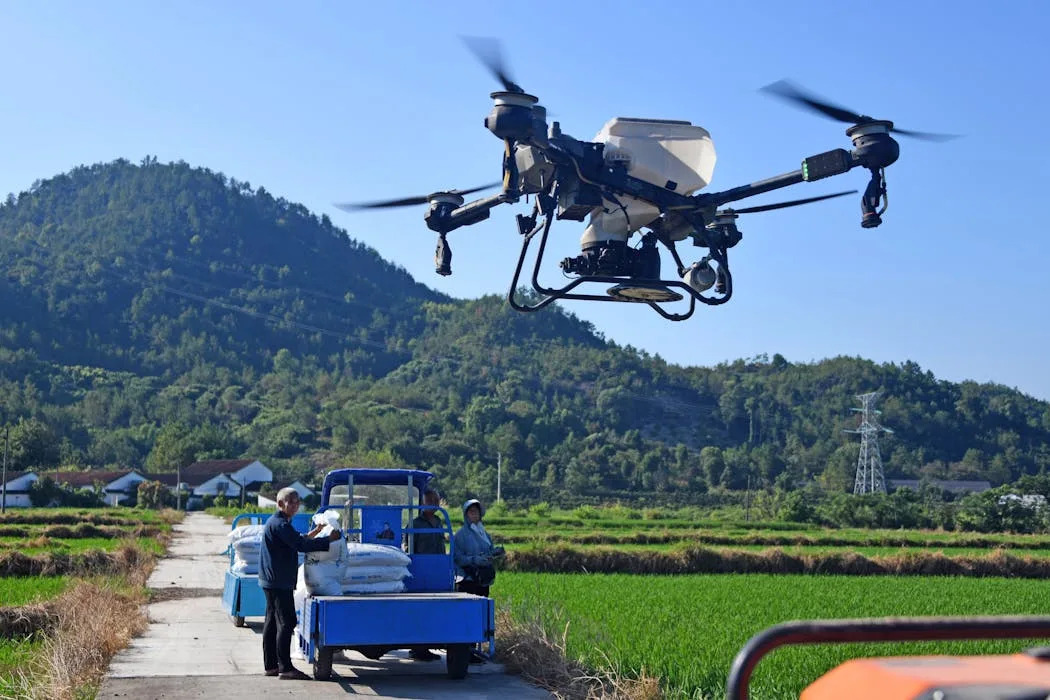
Agricultural drones are rapidly transforming farming practices across the globe, significantly enhancing efficiency and safety for farmers. A recent study published in the journal Science highlights the swift adoption of these technologies, revealing their impact on agricultural productivity and rural livelihoods. Researchers from Michigan State University, including Ben Belton and Leo Baldiga, examined the global spread of agricultural drones, their applications, and implications for farmers, the environment, and governments.
From Novelty to Necessity
In just a few years, the landscape of agricultural technology has shifted dramatically. Initially, agricultural drones were considered high-cost, niche tools, but modern models are now user-friendly and capable of carrying loads up to 220 pounds (approximately 100 kg). Their prices vary internationally; for example, farmers in the United States may spend between US$20,000 and US$30,000 for similar equipment that can be acquired in China for less than US$10,000. Despite the costs, many farmers opt for service providers, which offer drone operation at a fraction of the price, making this technology accessible to various agricultural enterprises.
Drones have evolved into versatile tools akin to flying tractors, performing tasks such as crop spraying, fertilizer spreading, seed sowing, and livestock monitoring. This multifunctionality is instrumental for farmers managing diverse crops across varying land sizes.
A Global Shift in Agricultural Practices
The research team estimated the number of operational agricultural drones in leading agricultural nations by analyzing a multitude of online news and trade publications. This investigation revealed a swift diffusion pattern, predominantly from East Asia to Southeast Asia, then extending to Latin America, and finally to regions like North America and Europe. While the adoption rate in wealthier countries has been slower, it is accelerating rapidly in the U.S., where the number of registered agricultural drones surged from approximately 1,000 in January 2024 to nearly 5,500 by mid-2025.
China stands at the forefront of this technological revolution, having introduced the first agriculture-specific quadcopter model in 2016. With over 250,000 drones reported in use, the country has set a precedent for drone adoption, with other middle-income nations like Thailand also embracing this technology. By 2023, drones were utilized on 30% of Thailand’s farmland, a significant increase from virtually none in 2019.
The versatility of agricultural drones is making them an integral part of modern farming, especially in regions where traditional methods are less feasible. In the U.S., these drones are primarily employed for crop spraying, particularly for corn and soy, in areas that are challenging for conventional machinery to access.
The transition from manual spraying with backpack sprayers to drone technology has not only improved efficiency but has also enhanced safety for farmers. By reducing direct exposure to hazardous chemicals, drones are helping to protect agricultural workers. Nonetheless, there are risks associated with their use; improper operation can lead to pesticide drift, affecting neighboring farms and waterways.
Drones are not only making agricultural tasks easier but also reshaping labor dynamics in rural economies. They save farmers time and reduce labor costs, particularly for smallholder farmers, who typically manage less than 5 acres (about 2 hectares) of land, comprising 85% of farms globally. By minimizing the physically demanding work of manual spraying, drones could make farming more appealing to younger generations, while also creating new job opportunities for drone pilots.
Nevertheless, the rise of drone technology poses challenges for traditional labor roles. In China, it is estimated that a drone can cover between 10 and 25 acres (approximately 4 to 10 hectares) per hour, which is equivalent to the output of 30 to 100 manual workers. This shift may necessitate government intervention to support displaced workers in finding new employment opportunities.
Future of Sustainable Agriculture
Drones facilitate the even and efficient application of fertilizers and seeds, potentially reducing waste and minimizing crop damage. This improvement may lead to increased yields per acre while utilizing fewer resources, a concept termed “sustainable intensification” by agricultural scientists. However, much of the evidence regarding yield benefits remains anecdotal or limited to small-scale studies.
The rapid adoption of drones is reshaping agricultural practices at an unprecedented pace. Over a span of five years, millions of farmers globally have integrated this technology into their operations. Early indications suggest substantial advantages, including enhanced efficiency, safer working conditions, and improved livelihoods in rural areas. As the technology continues to evolve, its full impact on agriculture remains to be seen, prompting enthusiasm and cautious optimism within the farming community.
This article is a synthesis of findings from the research conducted by Ben Belton and Leo Baldiga, who do not have any financial affiliations that could influence this work.

Philadelphia Parks Launch Free Earth Month Events Starting April 1

Bradford’s Fish Fry Fridays Serve Community with Delicious Dinners

Trump Faces Growing Challenges Amid Rising Tensions with Iran

Scientists Probe the Universe’s Missing Topological Defects

Samsung Galaxy Watch 9 to Feature Larger 435mAh Battery

UConn Huskies Aim to Defend Title in 2026 NCAA Women’s Tournament

U.S. Littoral Combat Ships Dock in Malaysia Amid Regional Tensions

Healthy Choice Wellness Reports Quarterly Earnings, Shares Rise

Urgent News: Charles M. Payment Passes Away at 78 in Duluth

University of Hawaiʻi Joins $25.6M AI Project to Enhance Disaster Monitoring

Major Grant Enhances Cancer Care and Research in Hawaiʻi

Joleen Chaney, Beloved Journalist, Passes Leaving Lasting Legacy

San Francisco’s SFO to Welcome 16 Airlines with Nonstop Flights to Europe in 2026

Goldman Sachs Unveils 2026 Catalyst Playbook for Biotech Investors

Discover Top Business Smartphones for Professionals in 2026

Urgent Update: Tom Aspinall’s Vision Deteriorates After UFC 321

Texas Roadhouse Honors Veterans with Free Meal Vouchers

CD Projekt Red Confirms No Release for The Witcher 4 in 2026
-
Science9 months ago
University of Hawaiʻi Joins $25.6M AI Project to Enhance Disaster Monitoring
-
 Health8 months ago
Major Grant Enhances Cancer Care and Research in Hawaiʻi
-
 Top Stories9 months ago
Joleen Chaney, Beloved Journalist, Passes Leaving Lasting Legacy
-
 World7 months ago
San Francisco’s SFO to Welcome 16 Airlines with Nonstop Flights to Europe in 2026
-
 Business8 months ago
Goldman Sachs Unveils 2026 Catalyst Playbook for Biotech Investors
-
 Business7 months ago
Discover Top Business Smartphones for Professionals in 2026
-
 Top Stories9 months ago
Urgent Update: Tom Aspinall’s Vision Deteriorates After UFC 321
-
 Lifestyle9 months ago
Texas Roadhouse Honors Veterans with Free Meal Vouchers
-
 Entertainment8 months ago
CD Projekt Red Confirms No Release for The Witcher 4 in 2026
-

 Top Stories10 months ago
AI Disruption: AWS Faces Threat as Startups Shift Cloud Focus
-

 Health10 months ago
MIT Scientists Uncover Surprising Genomic Loops During Cell Division
-

 Entertainment10 months ago
Discover the Full Map of Pokémon Legends: Z-A’s Lumiose City