
Science
Ancient Surgery Revealed in 2,500-Year-Old Mummy’s Jaw

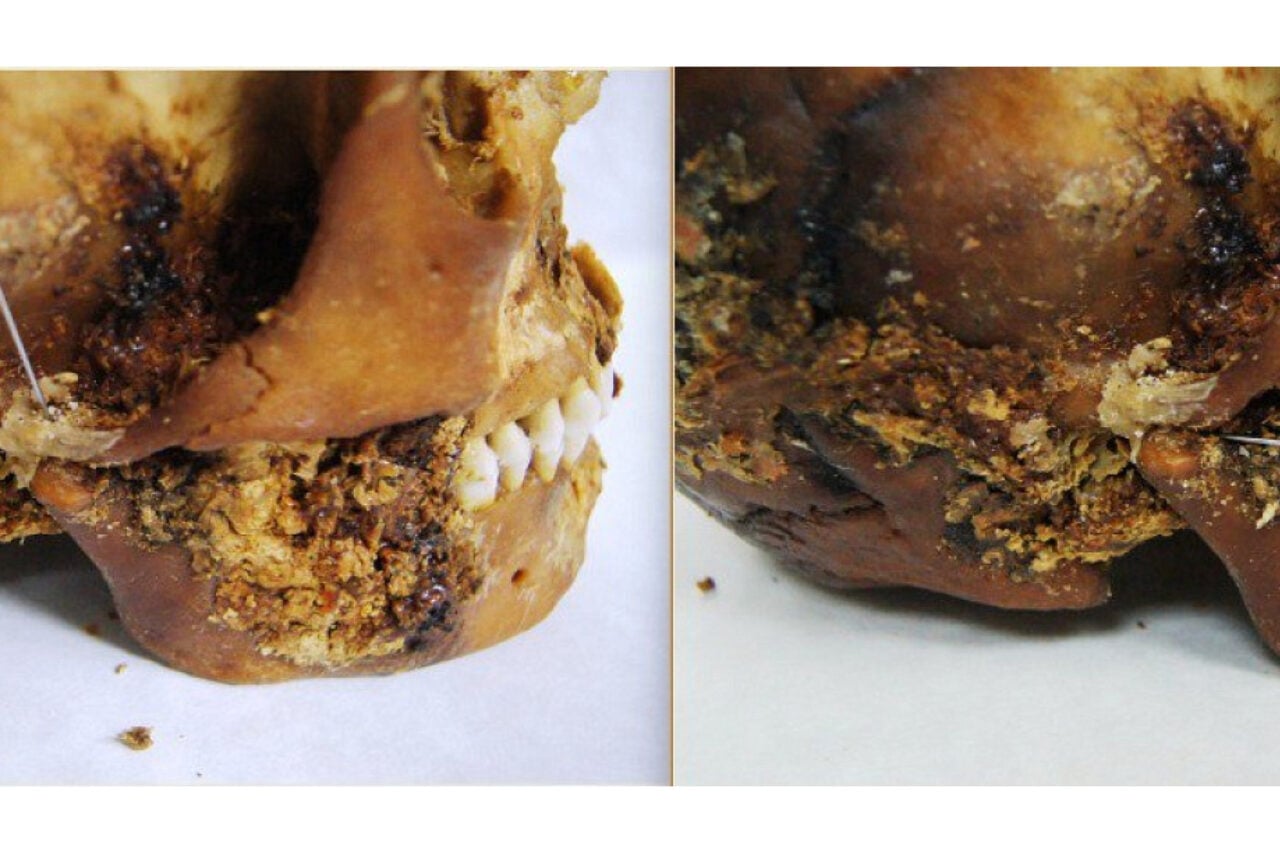
In a remarkable archaeological discovery, a mummified woman from the Iron Age has been found to have undergone jaw surgery, facilitated by a primitive prosthetic. This finding emerged from a recent analysis conducted by researchers at Novosibirsk State University in Russia, who revisited a grave unearthed in 1994 on the Ukok Plateau, a site linked to the ancient Pazyryk culture. Through advanced imaging techniques, the team identified evidence of severe trauma and the presence of surgical materials used to stabilize the woman’s jaw.
The woman’s skull, dating back approximately 2,500 years, revealed significant damage to her right temporomandibular joint (TMJ), indicating she suffered a serious head injury that likely impaired her ability to eat and speak. Vladimir Kanygin, head of the university’s Laboratory of Nuclear and Innovative Medicine, noted in a statement that the CT scanner functioned as a “time machine,” allowing researchers to explore the anatomical structures without disturbing the mummy.
Insights from Advanced Imaging
The scans unveiled more than anticipated. The injury had obliterated crucial joint structures, and further examination revealed thin canals drilled into the joint, suggesting that the woman had received surgical intervention. Researchers hypothesize that the ligature used for stabilization may have been made from horsehair or animal tendon. Notably, the condition of her teeth suggests she compensated for the injury, predominantly chewing with her left side, indicating her survival for some time following the surgery.
While the precise cause of her injury remains unclear, researchers speculate that a fall from a horse could have been the reason, reflecting the nomadic lifestyle of the Pazyryk people, who were known for their equestrian skills.
Understanding the Pazyryk Culture
This discovery aligns with what archaeologists have previously noted about the Pazyryk, who demonstrated advanced knowledge in treating injuries. The Siberian Ice Maiden, another well-preserved mummy from the same culture, showcases their intricate practices related to death and preservation. Natalia Polosmak, an archaeologist affiliated with the Russian Academy of Sciences, emphasized the Pazyryk’s proficiency in crafting sophisticated leather garments, suggesting that such skills contributed to their ability to perform complex surgeries.
The findings also shed light on the values of the Pazyryk society. The burial of the mummified woman, deemed “ordinary” compared to that of the Siberian Ice Maiden, implies she may have held a lower status. Despite her injuries leading to a likely distortion of her face and subsequent challenges in her daily life, the archaeological record demonstrates she was treated with care. Her wooden coffin, a valuable resource in the region, reflects a cultural respect for life that transcended social status.
As researchers continue to unravel the complexities of this ancient society, they highlight a fundamental truth: every individual, regardless of their physical condition, contributed to the community’s fabric. Polosmak eloquently remarked, “In this society, everyone was valued in life simply for their existence and honored after death.” This poignant observation encapsulates the resilience and depth of human experience, even in the harsh realities faced by the Pazyryk people thousands of years ago.

Philadelphia Parks Launch Free Earth Month Events Starting April 1

Bradford’s Fish Fry Fridays Serve Community with Delicious Dinners

Trump Faces Growing Challenges Amid Rising Tensions with Iran

Scientists Probe the Universe’s Missing Topological Defects

Samsung Galaxy Watch 9 to Feature Larger 435mAh Battery

UConn Huskies Aim to Defend Title in 2026 NCAA Women’s Tournament

U.S. Littoral Combat Ships Dock in Malaysia Amid Regional Tensions

Healthy Choice Wellness Reports Quarterly Earnings, Shares Rise

Urgent News: Charles M. Payment Passes Away at 78 in Duluth

University of Hawaiʻi Joins $25.6M AI Project to Enhance Disaster Monitoring

Major Grant Enhances Cancer Care and Research in Hawaiʻi

Joleen Chaney, Beloved Journalist, Passes Leaving Lasting Legacy

San Francisco’s SFO to Welcome 16 Airlines with Nonstop Flights to Europe in 2026

Goldman Sachs Unveils 2026 Catalyst Playbook for Biotech Investors

Discover Top Business Smartphones for Professionals in 2026

Urgent Update: Tom Aspinall’s Vision Deteriorates After UFC 321

Texas Roadhouse Honors Veterans with Free Meal Vouchers

CD Projekt Red Confirms No Release for The Witcher 4 in 2026
-
Science9 months ago
University of Hawaiʻi Joins $25.6M AI Project to Enhance Disaster Monitoring
-
 Health8 months ago
Major Grant Enhances Cancer Care and Research in Hawaiʻi
-
 Top Stories9 months ago
Joleen Chaney, Beloved Journalist, Passes Leaving Lasting Legacy
-
 World7 months ago
San Francisco’s SFO to Welcome 16 Airlines with Nonstop Flights to Europe in 2026
-
 Business8 months ago
Goldman Sachs Unveils 2026 Catalyst Playbook for Biotech Investors
-
 Business7 months ago
Discover Top Business Smartphones for Professionals in 2026
-
 Top Stories9 months ago
Urgent Update: Tom Aspinall’s Vision Deteriorates After UFC 321
-
 Lifestyle9 months ago
Texas Roadhouse Honors Veterans with Free Meal Vouchers
-
 Entertainment8 months ago
CD Projekt Red Confirms No Release for The Witcher 4 in 2026
-

 Top Stories10 months ago
AI Disruption: AWS Faces Threat as Startups Shift Cloud Focus
-

 Health10 months ago
MIT Scientists Uncover Surprising Genomic Loops During Cell Division
-

 Entertainment10 months ago
Discover the Full Map of Pokémon Legends: Z-A’s Lumiose City