
Science
Ariane 6 Rocket Launches Successfully, Boosting Europe’s Space Ambitions

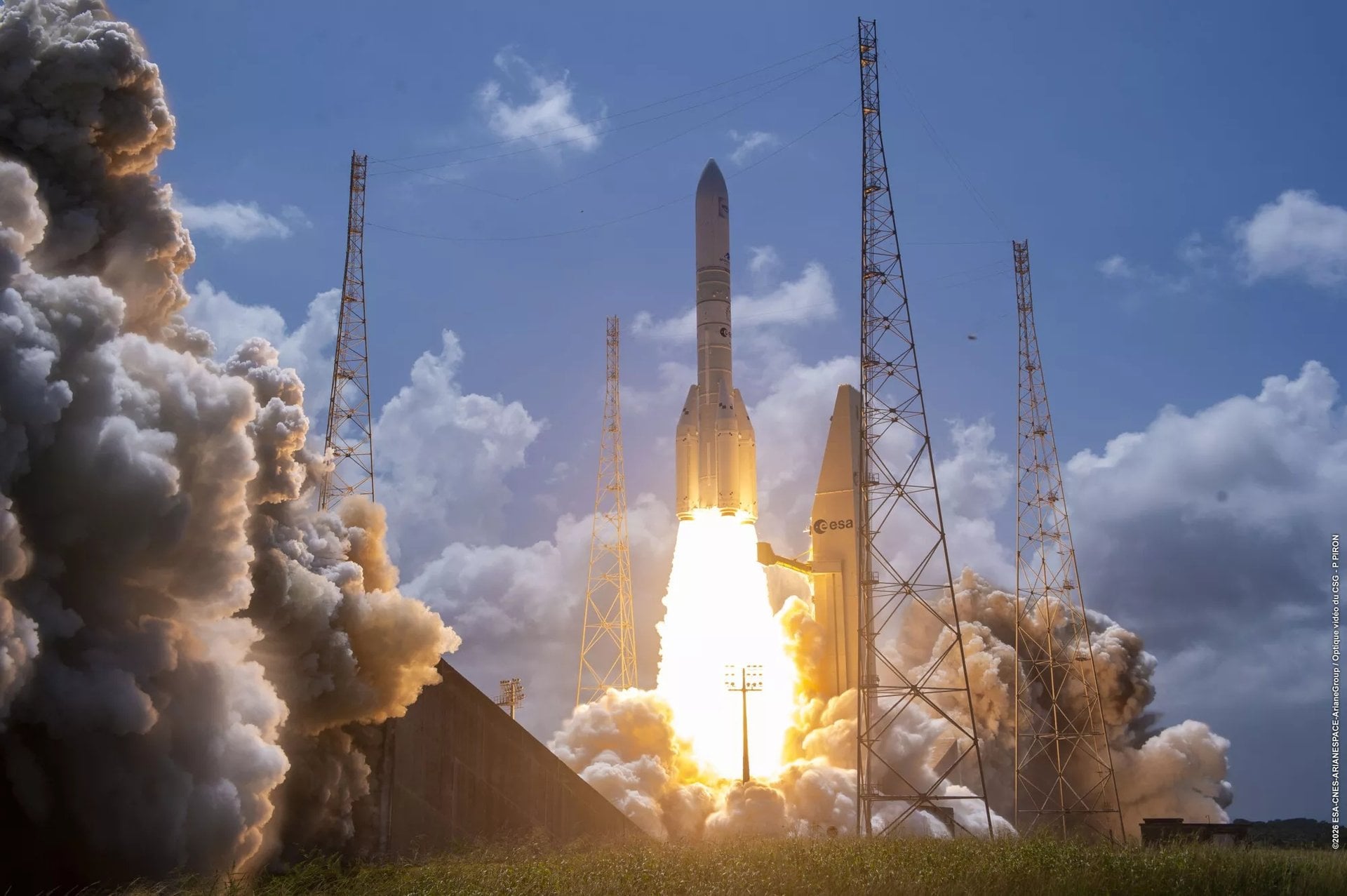
The European Space Agency (ESA) successfully launched the Ariane 6 rocket on February 12, 2024, marking a significant advancement in Europe’s space capabilities. The launch took place from Europe’s Spaceport in Kourou, French Guiana, at 1:45 p.m. local time. This mission, designated VA267, carried a payload of 32 satellites for Amazon’s Leo constellation, showcasing the rocket’s enhanced capabilities.
The Ariane 6 is a three-stage expendable launch system designed to replace the Ariane 5. The rocket’s initial configuration, known as the Ariane 62, featured two strap-on boosters, allowing it to carry a medium payload capacity of 10,350 kg (22,820 lb) to Low Earth Orbit (LEO) and 4,500 kg (9,900 lb) to geostationary orbit (GSO). The newly unveiled Ariane 64 version, however, includes four strap-on boosters, elevating its heavy-lift capacity to 21,650 kg (47,730 lb) to LEO and 11,500 kg (25,400 lb) to GSO.
New Era for European Launch Services
This maiden flight of the Ariane 64 is not just a technical achievement; it also represents a new era for the ESA. The successful launch positions Europe to pursue more ambitious space projects, ranging from scientific missions to commercial satellite deployments. The mission marks the first time a European launcher has serviced a satellite constellation, with a total of 18 launches planned in support of Amazon’s Leo constellation.
According to David Cavaillolès, CEO of Arianespace, the Ariane 6 is equipped with the P120C solid rocket booster, noted for being one of the largest and most powerful currently operational. This booster features a carbon-fiber design and carries approximately 143.6 metric tons (158.3 U.S. tons) of propellant, which consists of aluminum, ammonium perchlorate, and HTPB. Each booster produces an average thrust of about 4.5 meganewtons (1,000,000 lbf), with a specific impulse of 279 seconds (2.74 km/s).
Future Missions and Ambitions
The capabilities of the Ariane 6 will enable a range of future missions. Notable among them is the ESA’s exoplanet-hunting satellite, the PLAnetary Transits and Oscillations of stars (PLATO), which is scheduled for launch in January 2027. This mission aims to enhance the current exoplanet census by measuring the sizes of distant planets and characterizing their host stars to assess habitability.
Additionally, the ESA plans to deploy the Argonaut lunar lander, a crucial part of its lunar exploration strategy. This initiative envisions hundreds of landers delivering cargo to the Moon’s surface to support both robotic and crewed missions, including those within the framework of NASA’s Artemis program. The ultimate objective remains the establishment of an international lunar outpost, facilitating deeper exploration of our celestial neighbor.
As noted by Martin Sion, CEO of ArianeGroup, the Ariane 6’s successful launch underlines Europe’s capacity to lead in the rapidly evolving field of space exploration and commercial satellite services. The ESA’s advancements with the Ariane 6 will likely have significant implications for both scientific research and international collaboration in space initiatives.
The ESA has released a video showcasing the new rocket’s functionalities and the various missions it will support, highlighting the promising future of European space exploration.

Philadelphia Parks Launch Free Earth Month Events Starting April 1

Bradford’s Fish Fry Fridays Serve Community with Delicious Dinners

Trump Faces Growing Challenges Amid Rising Tensions with Iran

Scientists Probe the Universe’s Missing Topological Defects

Samsung Galaxy Watch 9 to Feature Larger 435mAh Battery

UConn Huskies Aim to Defend Title in 2026 NCAA Women’s Tournament

U.S. Littoral Combat Ships Dock in Malaysia Amid Regional Tensions

Healthy Choice Wellness Reports Quarterly Earnings, Shares Rise

Urgent News: Charles M. Payment Passes Away at 78 in Duluth

University of Hawaiʻi Joins $25.6M AI Project to Enhance Disaster Monitoring

Major Grant Enhances Cancer Care and Research in Hawaiʻi

Joleen Chaney, Beloved Journalist, Passes Leaving Lasting Legacy

San Francisco’s SFO to Welcome 16 Airlines with Nonstop Flights to Europe in 2026

Goldman Sachs Unveils 2026 Catalyst Playbook for Biotech Investors

Discover Top Business Smartphones for Professionals in 2026

Urgent Update: Tom Aspinall’s Vision Deteriorates After UFC 321

Texas Roadhouse Honors Veterans with Free Meal Vouchers

CD Projekt Red Confirms No Release for The Witcher 4 in 2026
-
Science9 months ago
University of Hawaiʻi Joins $25.6M AI Project to Enhance Disaster Monitoring
-
 Health8 months ago
Major Grant Enhances Cancer Care and Research in Hawaiʻi
-
 Top Stories9 months ago
Joleen Chaney, Beloved Journalist, Passes Leaving Lasting Legacy
-
 World7 months ago
San Francisco’s SFO to Welcome 16 Airlines with Nonstop Flights to Europe in 2026
-
 Business8 months ago
Goldman Sachs Unveils 2026 Catalyst Playbook for Biotech Investors
-
 Business7 months ago
Discover Top Business Smartphones for Professionals in 2026
-
 Top Stories9 months ago
Urgent Update: Tom Aspinall’s Vision Deteriorates After UFC 321
-
 Lifestyle9 months ago
Texas Roadhouse Honors Veterans with Free Meal Vouchers
-
 Entertainment8 months ago
CD Projekt Red Confirms No Release for The Witcher 4 in 2026
-

 Top Stories10 months ago
AI Disruption: AWS Faces Threat as Startups Shift Cloud Focus
-

 Health10 months ago
MIT Scientists Uncover Surprising Genomic Loops During Cell Division
-

 Entertainment10 months ago
Discover the Full Map of Pokémon Legends: Z-A’s Lumiose City