
Science
Astronomers Discover Unique Exoplanet Orbiting Twin Stars

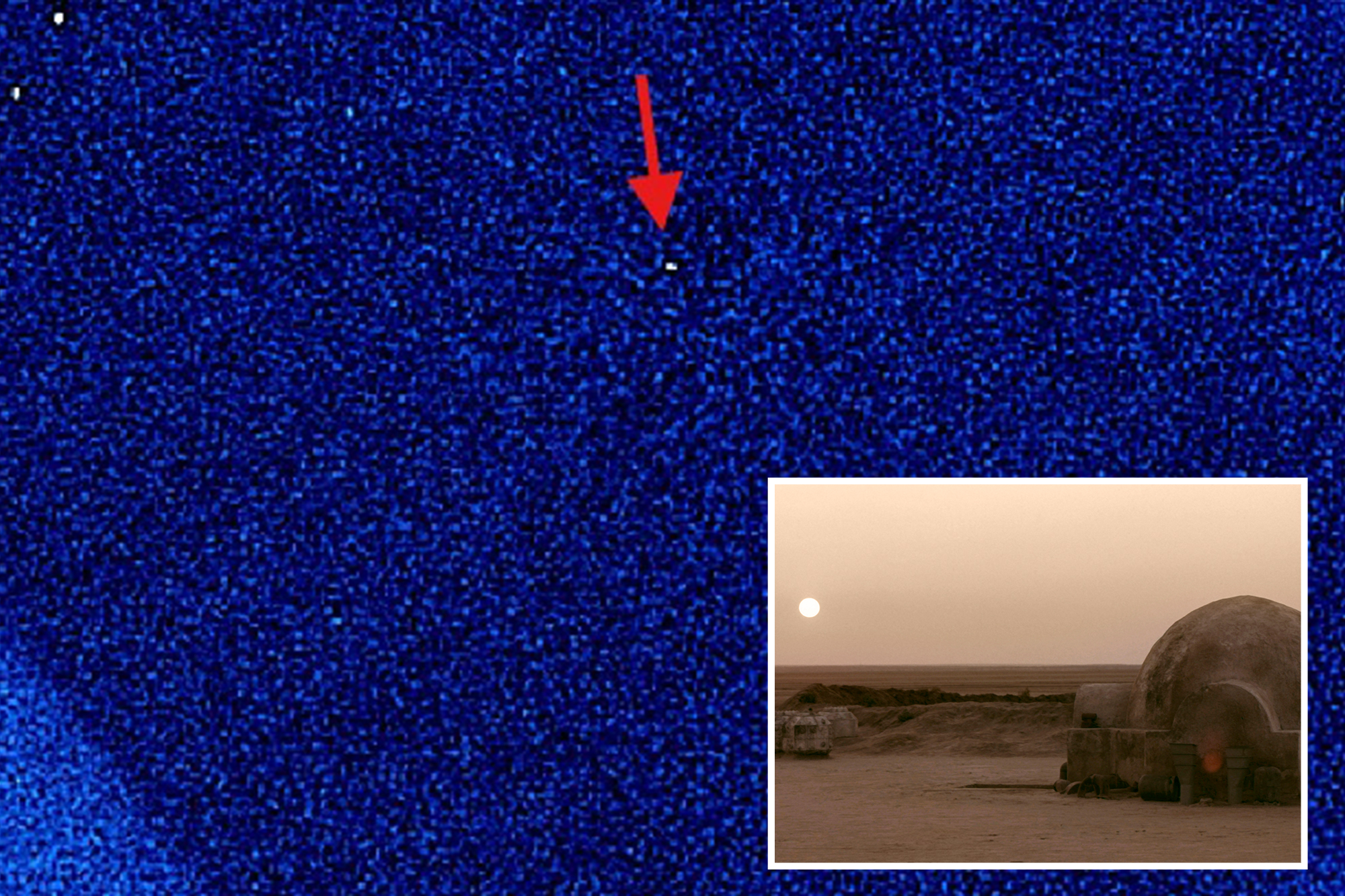
A team of astronomers has made a groundbreaking discovery of a unique exoplanet, designated HD 143811 AB b, which orbits two stars in a binary system. This planet, located approximately 446 light-years from Earth, has been likened to the fictional home of Luke Skywalker in Star Wars, Tatooine, due to its dual suns. The findings were published in the journal Astronomy & Astrophysics.
Researchers from Northwestern University in Chicago, Illinois, shared a time-lapse video that captures the planet’s orbit around its twin stars. Notably, HD 143811 AB b is positioned closer to its suns than any previously observed binary star system exoplanet, providing a unique opportunity for scientists to analyze its trajectory and the dynamics of the star system.
According to Jason Wang, an expert in exoplanet imaging and a member of the research team, “Of the 6,000 exoplanets that we know of, only a very small fraction of them orbit binaries.” He emphasized the significance of capturing direct images of both the planet and its binary stars, stating, “It’s the only type of planetary system where we can trace both the orbit of the binary star and the planet in the sky at the same time.”
Despite being relatively close to its suns, HD 143811 AB b is still about 80 times farther from its stars than Earth is from the Sun. This distance means it takes approximately 300 years for the planet to complete one revolution around its twin suns, which themselves orbit each other every 18 days. The planet is also significantly larger than Jupiter, measuring roughly six times its size.
Interestingly, the discovery of HD 143811 AB b is not entirely new. The planet was identified in archival data collected a decade ago by the Gemini South telescope using its Gemini Planet Imager (GPI). Wang and his colleagues revisited this data, which included observations from 2016 and 2019, and cross-referenced it with information from the W.M. Keck Observatory. They were surprised to find a faint dot moving in conjunction with a star, indicating it was indeed a planet.
Wang explained the importance of tracking the movement of celestial bodies. “If a planet is bound to a star, then it will move with the star,” he noted. “Sometimes, when we revisit a ‘planet,’ we find it’s not moving with its star. Then, we know it was just a photobombing star passing through.” The confirmation of HD 143811 AB b as a planet was also corroborated by astronomers from the University of Exeter in the UK.
Among the intriguing characteristics of this exoplanet, scientists have noted that it reaches temperatures of approximately 1,416°F, nearly twice as hot as Venus. The planet is estimated to be around 13 million years old, which is relatively young in cosmic terms, especially when considering that Earth formed around 4.6 billion years ago.
Despite the exciting discoveries, the formation of this planet around its twin stars remains a mystery. Wang stated, “Exactly how it works is still uncertain. Because we have only detected a few dozen planets like this, we don’t have enough data yet to put the picture together.” The research team aims to continue monitoring the orbits of HD 143811 AB b and its binary stars to gain more insights into the interactions between binary stars and their orbiting planets.

Philadelphia Parks Launch Free Earth Month Events Starting April 1

Bradford’s Fish Fry Fridays Serve Community with Delicious Dinners

Trump Faces Growing Challenges Amid Rising Tensions with Iran

Scientists Probe the Universe’s Missing Topological Defects

Samsung Galaxy Watch 9 to Feature Larger 435mAh Battery

UConn Huskies Aim to Defend Title in 2026 NCAA Women’s Tournament

U.S. Littoral Combat Ships Dock in Malaysia Amid Regional Tensions

Healthy Choice Wellness Reports Quarterly Earnings, Shares Rise

Urgent News: Charles M. Payment Passes Away at 78 in Duluth

University of Hawaiʻi Joins $25.6M AI Project to Enhance Disaster Monitoring

Major Grant Enhances Cancer Care and Research in Hawaiʻi

Joleen Chaney, Beloved Journalist, Passes Leaving Lasting Legacy

San Francisco’s SFO to Welcome 16 Airlines with Nonstop Flights to Europe in 2026

Goldman Sachs Unveils 2026 Catalyst Playbook for Biotech Investors

Discover Top Business Smartphones for Professionals in 2026

Urgent Update: Tom Aspinall’s Vision Deteriorates After UFC 321

Texas Roadhouse Honors Veterans with Free Meal Vouchers

CD Projekt Red Confirms No Release for The Witcher 4 in 2026
-
Science9 months ago
University of Hawaiʻi Joins $25.6M AI Project to Enhance Disaster Monitoring
-
 Health8 months ago
Major Grant Enhances Cancer Care and Research in Hawaiʻi
-
 Top Stories9 months ago
Joleen Chaney, Beloved Journalist, Passes Leaving Lasting Legacy
-
 World7 months ago
San Francisco’s SFO to Welcome 16 Airlines with Nonstop Flights to Europe in 2026
-
 Business8 months ago
Goldman Sachs Unveils 2026 Catalyst Playbook for Biotech Investors
-
 Business8 months ago
Discover Top Business Smartphones for Professionals in 2026
-
 Top Stories9 months ago
Urgent Update: Tom Aspinall’s Vision Deteriorates After UFC 321
-
 Lifestyle9 months ago
Texas Roadhouse Honors Veterans with Free Meal Vouchers
-
 Entertainment8 months ago
CD Projekt Red Confirms No Release for The Witcher 4 in 2026
-

 Top Stories10 months ago
AI Disruption: AWS Faces Threat as Startups Shift Cloud Focus
-

 Health10 months ago
MIT Scientists Uncover Surprising Genomic Loops During Cell Division
-

 Entertainment10 months ago
Discover the Full Map of Pokémon Legends: Z-A’s Lumiose City