
Science
Astronomers Uncover Largest Rotating Cosmic Structure Yet

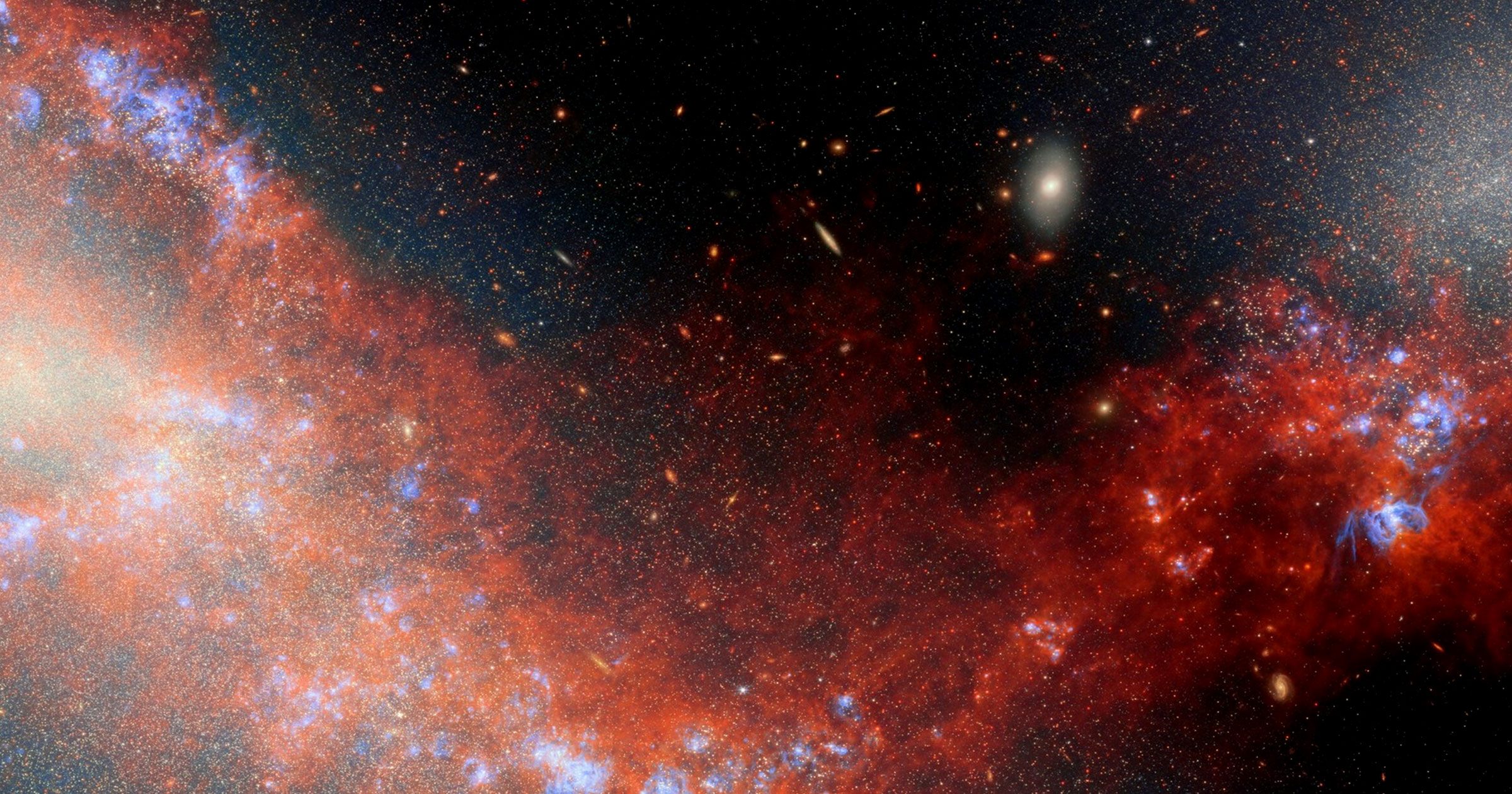
Astronomers have detected a colossal rotating structure in space, providing new insights into the formation of galaxies. This discovery involves immense filaments of galaxies interconnected by dark matter, which scientists believe constitutes approximately 85 percent of the universe’s total mass. The findings, published in March 2024 in the journal Monthly Notices of the Royal Astronomical Society, detail an extraordinary arrangement of galaxies observed using the MeerKAT radio telescope in South Africa.
The research team, led by the University of Oxford, identified a spinning structure comprising 14 galaxies. This structure, measuring about 5.5 million light-years in length and 117,000 light-years in width, resides within a larger filament that contains an additional 280 galaxies and extends to 50 million light-years. Notably, many of these galaxies appear to rotate in alignment with the filament itself, indicating a coordinated cosmic motion.
“This is the largest individual spinning structure so far detected,” said Lyla Jung, a postdoctoral researcher at the University of Oxford and one of the study’s co-leads. She emphasized the potential for discovering even larger spinning structures, although current data and technology have yet to reveal them.
The implications of this discovery suggest that such structures can influence the rotational dynamics of galaxies more profoundly and over longer time periods than previously understood. Jung elaborated, “What makes this structure exceptional is not just its size, but the combination of spin alignment and rotational motion.” She likened this phenomenon to a theme park teacup ride, where each galaxy resembles a spinning teacup while the entire platform—represented by the cosmic filament—also rotates.
The study indicates that this filament is relatively young, categorized as being in a “dynamically cold” state. The galaxies within are rich in hydrogen gas, suggesting they may still be in the process of accumulating fuel necessary for star formation. This presents an intriguing opportunity to observe the early stages of galaxy evolution.
“This filament is a fossil record of cosmic flows,” remarked Madalina Tudorache, a postdoctoral research assistant at the University of Cambridge and co-lead of the research. The findings also indicate how gas circulates within the filament, which could assist future observations by the European Space Agency’s Euclid mission and the Vera C. Rubin Observatory in Chile.
As advancements in radio and optical surveys continue, Tudorache expressed enthusiasm about the field’s future, stating, “This is a very exciting time to work in this field, as our capacity of discovering such structures is increasing. It will deepen our understanding of the universe.”
The identification of this rotating cosmic structure not only enhances our knowledge of galaxy formation but also opens new avenues for exploration in cosmic dynamics.

Philadelphia Parks Launch Free Earth Month Events Starting April 1

Bradford’s Fish Fry Fridays Serve Community with Delicious Dinners

Trump Faces Growing Challenges Amid Rising Tensions with Iran

Scientists Probe the Universe’s Missing Topological Defects

Samsung Galaxy Watch 9 to Feature Larger 435mAh Battery

UConn Huskies Aim to Defend Title in 2026 NCAA Women’s Tournament

U.S. Littoral Combat Ships Dock in Malaysia Amid Regional Tensions

Healthy Choice Wellness Reports Quarterly Earnings, Shares Rise

Urgent News: Charles M. Payment Passes Away at 78 in Duluth

University of Hawaiʻi Joins $25.6M AI Project to Enhance Disaster Monitoring

Major Grant Enhances Cancer Care and Research in Hawaiʻi

Joleen Chaney, Beloved Journalist, Passes Leaving Lasting Legacy

San Francisco’s SFO to Welcome 16 Airlines with Nonstop Flights to Europe in 2026

Goldman Sachs Unveils 2026 Catalyst Playbook for Biotech Investors

Discover Top Business Smartphones for Professionals in 2026

Urgent Update: Tom Aspinall’s Vision Deteriorates After UFC 321

Texas Roadhouse Honors Veterans with Free Meal Vouchers

CD Projekt Red Confirms No Release for The Witcher 4 in 2026
-
Science9 months ago
University of Hawaiʻi Joins $25.6M AI Project to Enhance Disaster Monitoring
-
 Health8 months ago
Major Grant Enhances Cancer Care and Research in Hawaiʻi
-
 Top Stories9 months ago
Joleen Chaney, Beloved Journalist, Passes Leaving Lasting Legacy
-
 World7 months ago
San Francisco’s SFO to Welcome 16 Airlines with Nonstop Flights to Europe in 2026
-
 Business8 months ago
Goldman Sachs Unveils 2026 Catalyst Playbook for Biotech Investors
-
 Business8 months ago
Discover Top Business Smartphones for Professionals in 2026
-
 Top Stories9 months ago
Urgent Update: Tom Aspinall’s Vision Deteriorates After UFC 321
-
 Lifestyle9 months ago
Texas Roadhouse Honors Veterans with Free Meal Vouchers
-
 Entertainment8 months ago
CD Projekt Red Confirms No Release for The Witcher 4 in 2026
-

 Top Stories10 months ago
AI Disruption: AWS Faces Threat as Startups Shift Cloud Focus
-

 Health10 months ago
MIT Scientists Uncover Surprising Genomic Loops During Cell Division
-

 Entertainment10 months ago
Discover the Full Map of Pokémon Legends: Z-A’s Lumiose City