
Science
Astronomers Uncover Mystery of Seven-Hour Gamma-Ray Burst

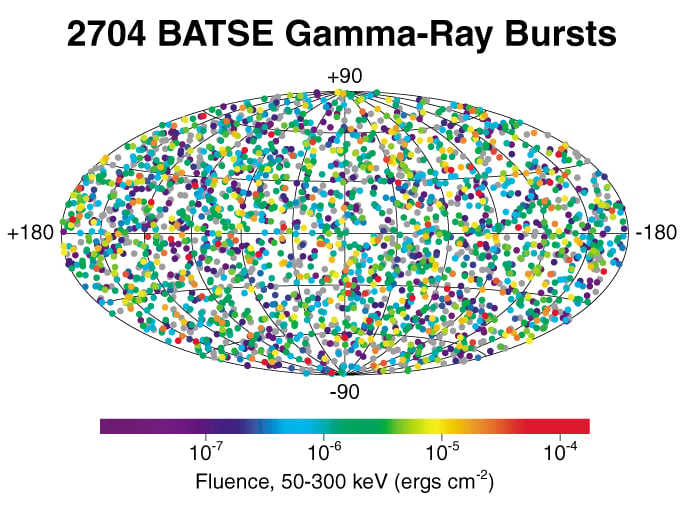
On July 2, 2025, astronomers detected a remarkable phenomenon known as GRB 250702B, marking it as the longest gamma-ray burst ever recorded. Unlike typical bursts that last only seconds or minutes, this event persisted for an astonishing seven hours, emitting three distinct bursts throughout the day and leaving behind an afterglow that lasted for months. This unprecedented event has captured the attention of astronomers worldwide, as it deviates significantly from the characteristics of previously catalogued gamma-ray bursts.
Gamma-ray bursts are noted for their extreme violence, releasing more energy in a fraction of a second than the Sun will emit over its entire ten billion-year lifespan. Since the phenomenon was first identified in 1973, around 15,000 bursts have been catalogued, but only a few approach the duration of GRB 250702B. The event was detected by the NASA Fermi Gamma-ray Space Telescope, leading researchers to conclude that they were witnessing something entirely new. “This is certainly an outburst unlike any other we’ve seen in the past 50 years,” stated a member of the detection team.
Exploring New Theories
A recent paper published in the Monthly Notices of the Royal Astronomical Society delves into one of the most intriguing possibilities regarding GRB 250702B: the involvement of an intermediate mass black hole. Black holes generally fall into two categories: stellar mass black holes, which are a few times heavier than the Sun, and supermassive black holes, which can weigh millions or billions of solar masses. However, the intermediate mass black holes, which range from a few hundred to a hundred thousand solar masses, remain largely elusive, despite theoretical predictions suggesting they should be common in the universe.
Researchers propose that GRB 250702B may have been produced when a star similar to our Sun passed too close to one of these intermediate mass black holes. The intense tidal forces could have torn the star apart, leading to a series of bursts as the stellar material spiraled inward, forming a relativistic jet of particles moving at nearly the speed of light. This model aligns well with the repeating nature of the bursts, as the star may not have been completely destroyed in one sudden event. Instead, it could have experienced multiple close encounters, each generating a new burst of emissions.
Significance of the Discovery
The location of GRB 250702B adds another layer of intrigue. Positioned approximately 5.7 kiloparsecs from the center of its host galaxy, the event resides far from the supermassive black hole typically found at the galaxy’s core. This distance aligns with expectations for a wandering intermediate mass black hole. If the proposed theory holds true, GRB 250702B would represent humanity’s first observation of a relativistic jet generated by an intermediate mass black hole consuming a star, making it one of the most significant astronomical discoveries of the decade.
Despite the promising theory, the mystery surrounding GRB 250702B remains unsolved, with several competing models still in consideration. The evidence continues to be debated among astronomers, illustrating the complexity of such astronomical phenomena. As discoveries in this field often arrive unexpectedly, the seven-hour explosion that eludes complete understanding serves as a compelling puzzle that propels astronomical research forward.

Philadelphia Parks Launch Free Earth Month Events Starting April 1

Bradford’s Fish Fry Fridays Serve Community with Delicious Dinners

Trump Faces Growing Challenges Amid Rising Tensions with Iran

Scientists Probe the Universe’s Missing Topological Defects

Samsung Galaxy Watch 9 to Feature Larger 435mAh Battery

UConn Huskies Aim to Defend Title in 2026 NCAA Women’s Tournament

U.S. Littoral Combat Ships Dock in Malaysia Amid Regional Tensions

Healthy Choice Wellness Reports Quarterly Earnings, Shares Rise

Urgent News: Charles M. Payment Passes Away at 78 in Duluth

University of Hawaiʻi Joins $25.6M AI Project to Enhance Disaster Monitoring

Major Grant Enhances Cancer Care and Research in Hawaiʻi

Joleen Chaney, Beloved Journalist, Passes Leaving Lasting Legacy

San Francisco’s SFO to Welcome 16 Airlines with Nonstop Flights to Europe in 2026

Goldman Sachs Unveils 2026 Catalyst Playbook for Biotech Investors

Discover Top Business Smartphones for Professionals in 2026

Urgent Update: Tom Aspinall’s Vision Deteriorates After UFC 321

Texas Roadhouse Honors Veterans with Free Meal Vouchers

CD Projekt Red Confirms No Release for The Witcher 4 in 2026
-
Science9 months ago
University of Hawaiʻi Joins $25.6M AI Project to Enhance Disaster Monitoring
-
 Health8 months ago
Major Grant Enhances Cancer Care and Research in Hawaiʻi
-
 Top Stories9 months ago
Joleen Chaney, Beloved Journalist, Passes Leaving Lasting Legacy
-
 World7 months ago
San Francisco’s SFO to Welcome 16 Airlines with Nonstop Flights to Europe in 2026
-
 Business8 months ago
Goldman Sachs Unveils 2026 Catalyst Playbook for Biotech Investors
-
 Business7 months ago
Discover Top Business Smartphones for Professionals in 2026
-
 Top Stories9 months ago
Urgent Update: Tom Aspinall’s Vision Deteriorates After UFC 321
-
 Lifestyle9 months ago
Texas Roadhouse Honors Veterans with Free Meal Vouchers
-
 Entertainment8 months ago
CD Projekt Red Confirms No Release for The Witcher 4 in 2026
-

 Top Stories10 months ago
AI Disruption: AWS Faces Threat as Startups Shift Cloud Focus
-

 Health10 months ago
MIT Scientists Uncover Surprising Genomic Loops During Cell Division
-

 Entertainment10 months ago
Discover the Full Map of Pokémon Legends: Z-A’s Lumiose City