
Science
KIST Unveils Innovative Eco-Friendly Technology for Palladium Recovery

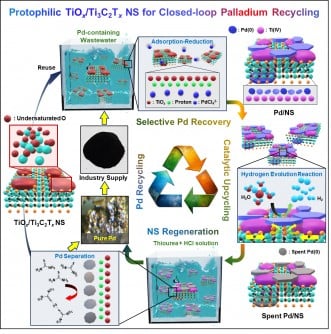
Palladium, a crucial metal used in smartphones, semiconductors, and hydrogen fuel cells, has traditionally faced supply challenges due to its concentrated production in a limited number of countries. Now, researchers at the Korea Institute of Science and Technology (KIST) have developed an eco-friendly technology that promises to enhance resource security by recovering palladium from industrial waste effectively and sustainably.
Led by Dr. Jae-Woo Choi from the Water Resources Recycling Research Group and Dr. Jin Young Kim from the Center for Hydrogen and Fuel Cells, the team has created a technology utilizing titanium-based maxene material, specifically ‘TiOx/Ti3C2Tx’ nanosheets. This innovative approach allows for the recovery of high-purity palladium—up to 99.9%—in just 30 minutes, even from weakly acidic wastewater, a common byproduct of industrial processes.
Traditional recovery methods often require strongly acidic environments, limiting their effectiveness. The new technology overcomes this barrier by incorporating a high-density arrangement of ‘TiOx nanoclusters’ that feature unsaturated oxygen on their surfaces. Remarkably, this method operates without toxic chemicals or a power supply. Instead, the palladium naturally reduces to its metallic state, allowing for straightforward separation through filtration.
The implications of this technology extend far beyond efficiency. By utilizing a process that operates at room temperature and avoids high-temperature treatments, KIST researchers estimate that carbon emissions could be reduced by as much as 80% compared to conventional acid-based methods. Additionally, the technology supports a sustainable model, as the recovered palladium can be recycled back into hydrogen evolution catalysts, reinforcing a complete precious metal recycling system.
With an impressive adsorption performance of 1,983 mg/g, the titanium-based maxene material demonstrates approximately 90% efficiency even after more than ten reuse cycles, confirming its durability and reusability. This versatility positions the technology as a valuable asset across various industries, including refining, petrochemicals, automotive, and electronics.
KIST’s research is part of a broader initiative to ensure Korea’s self-sufficiency in precious metal recovery technology. Through technology transfer and commercialization efforts, researchers aim to decrease reliance on imported metals, addressing both economic and environmental concerns. Future developments are expected to include recovery technologies for other precious metals, such as platinum, gold, and silver.
In a statement, Dr. Jae-Woo Choi remarked, “This research represents a technological turning point that can contribute to the self-sufficiency of Korea’s resource circulation system and reduce dependence on precious metal imports by enabling the easy recovery of precious metals previously discarded in spent catalysts or electronic waste.” He further emphasized the goal of enhancing commercialization potential by developing a modular recovery system.
Meanwhile, Dr. Jin Young Kim explained the broader applications of the recovered palladium, stating, “We confirmed that the recovered palladium can be applied not merely as recycled material, but as an electrochemical electrode catalyst material for producing high-efficiency hydrogen.” This reflects a significant shift in how precious metals can be utilized, moving from waste to a vital resource in clean energy production.
KIST, established in 1966 as South Korea’s first government-funded research institute, continues to address national and social challenges through innovative research. The findings from this study were published in the latest issue of the international journal Advanced Functional Materials, highlighting the potential impact of this research on the global market for precious metal recovery.
As KIST moves forward, the focus will remain on developing comprehensive solutions for resource recycling, reinforcing the importance of environmental sustainability in technological advancement. For more information about their research and initiatives, visit KIST’s official website at https://www.kist.re.kr/eng/index.do.

Philadelphia Parks Launch Free Earth Month Events Starting April 1

Bradford’s Fish Fry Fridays Serve Community with Delicious Dinners

Trump Faces Growing Challenges Amid Rising Tensions with Iran

Scientists Probe the Universe’s Missing Topological Defects

Samsung Galaxy Watch 9 to Feature Larger 435mAh Battery

UConn Huskies Aim to Defend Title in 2026 NCAA Women’s Tournament

U.S. Littoral Combat Ships Dock in Malaysia Amid Regional Tensions

Healthy Choice Wellness Reports Quarterly Earnings, Shares Rise

Urgent News: Charles M. Payment Passes Away at 78 in Duluth

University of Hawaiʻi Joins $25.6M AI Project to Enhance Disaster Monitoring

Major Grant Enhances Cancer Care and Research in Hawaiʻi

Joleen Chaney, Beloved Journalist, Passes Leaving Lasting Legacy

San Francisco’s SFO to Welcome 16 Airlines with Nonstop Flights to Europe in 2026

Goldman Sachs Unveils 2026 Catalyst Playbook for Biotech Investors

Discover Top Business Smartphones for Professionals in 2026

Urgent Update: Tom Aspinall’s Vision Deteriorates After UFC 321

Texas Roadhouse Honors Veterans with Free Meal Vouchers

CD Projekt Red Confirms No Release for The Witcher 4 in 2026
-
Science9 months ago
University of Hawaiʻi Joins $25.6M AI Project to Enhance Disaster Monitoring
-
 Health8 months ago
Major Grant Enhances Cancer Care and Research in Hawaiʻi
-
 Top Stories9 months ago
Joleen Chaney, Beloved Journalist, Passes Leaving Lasting Legacy
-
 World7 months ago
San Francisco’s SFO to Welcome 16 Airlines with Nonstop Flights to Europe in 2026
-
 Business8 months ago
Goldman Sachs Unveils 2026 Catalyst Playbook for Biotech Investors
-
 Business8 months ago
Discover Top Business Smartphones for Professionals in 2026
-
 Top Stories9 months ago
Urgent Update: Tom Aspinall’s Vision Deteriorates After UFC 321
-
 Lifestyle9 months ago
Texas Roadhouse Honors Veterans with Free Meal Vouchers
-
 Entertainment8 months ago
CD Projekt Red Confirms No Release for The Witcher 4 in 2026
-

 Top Stories10 months ago
AI Disruption: AWS Faces Threat as Startups Shift Cloud Focus
-

 Health10 months ago
MIT Scientists Uncover Surprising Genomic Loops During Cell Division
-

 Entertainment10 months ago
Discover the Full Map of Pokémon Legends: Z-A’s Lumiose City