
Science
Martian Storms Uncover Secrets of Water Loss on Red Planet

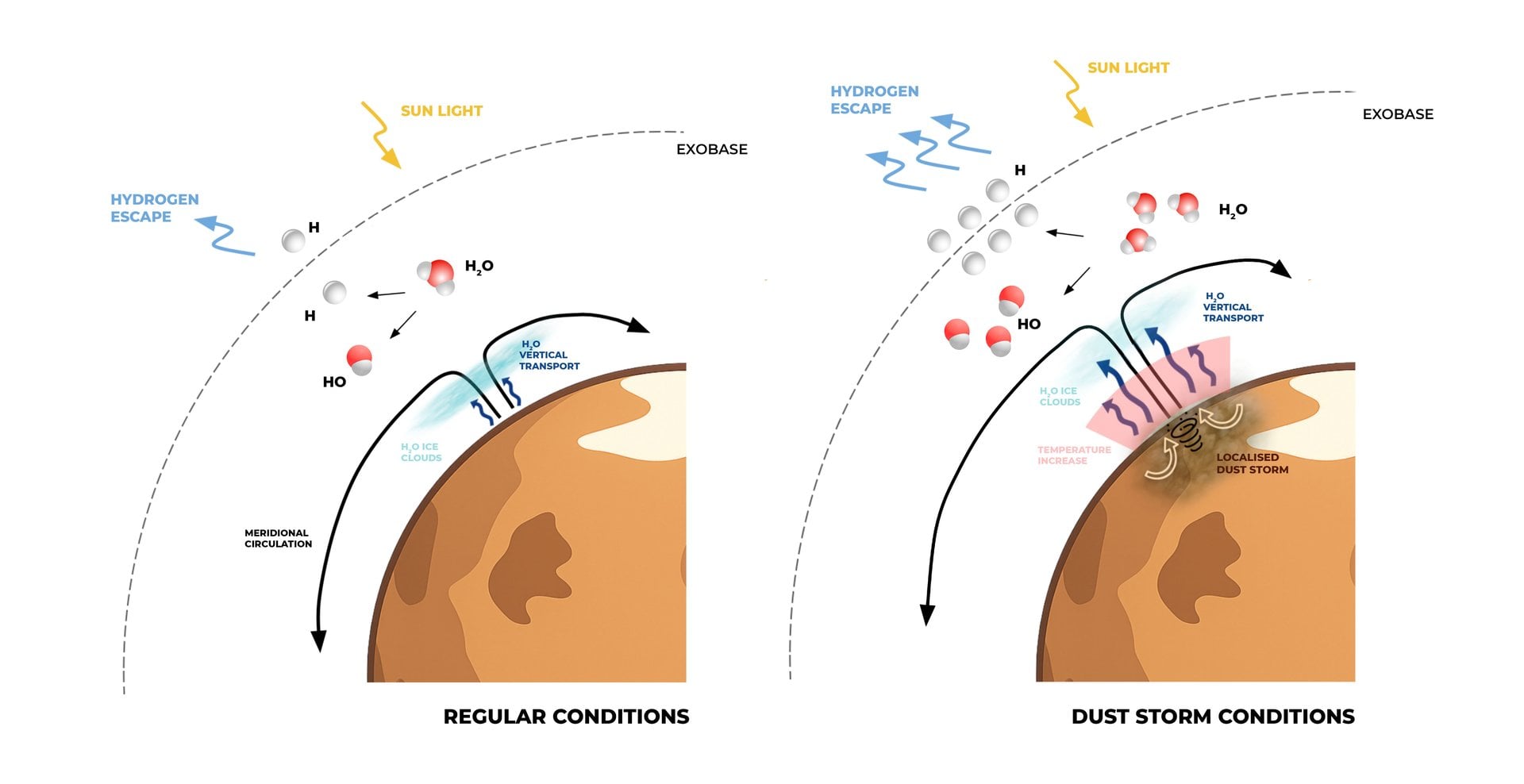
Mars has experienced significant water loss over its history, and recent research sheds light on how this occurred. A study combining data from six instruments on three spacecraft reveals that dust storms play a crucial role in pushing water into the Martian atmosphere, where it is subsequently destroyed throughout the year.
Scientists have long debated the fate of water that once covered the Martian surface to a depth of hundreds of meters. Instruments aboard rovers such as Perseverance and Curiosity, along with orbiters including the Mars Reconnaissance Orbiter and ExoMars, have provided evidence that Mars once had a robust hydrodynamic cycle. To understand its current state, researchers utilized a technique measuring the deuterium/hydrogen (D/H) ratio. This ratio indicates that Mars has 5-8 times the D/H ratio found on Earth, suggesting a substantial historical presence of water.
Understanding the Martian seasons is critical to solving the mystery of water loss. Mars has an axial tilt similar to Earth, resulting in distinct seasonal changes. However, its more elliptical orbit leads to significant temperature variations between its closest and farthest points from the Sun. Traditionally, scientists believed that water loss into the atmosphere primarily occurred during the warmer Southern summers.
A recent publication challenges this assumption. It discusses a powerful dust storm that took place during the Northern summer in Mars year 37 (2022-2023 for Earth). This storm demonstrated that significant water loss can happen even outside the expected Southern summer periods.
Discoveries from the Martian Dust Cycle
The study indicates that during warmer Southern summers, dust storms elevate dust into the middle layers of the atmosphere, raising temperatures by approximately 15°C. This warming prevents the formation of water ice clouds that typically trap water at lower altitudes. Instead, water is pushed into the upper atmosphere, where it is vulnerable to destruction by ultraviolet radiation, resulting in the loss of hydrogen atoms to solar wind.
Data from the ExoMars mission, the Emirates Mars Mission (EMM), and the Mars Reconnaissance Orbiter captured the unprecedented storm, confirming that the mechanisms of water loss are active year-round. Researchers highlighted that this finding suggests the cyclical nature of dust storms and their impact on water loss is not limited to specific seasons, broadening our understanding of Mars’ atmospheric dynamics.
The researchers posit that in Mars’ earlier history, the planet’s axial tilt may have been greater, potentially leading to even more intense storms during what would have been warmer Northern summers. This additional “escape pathway” for water might explain the discrepancies between the current volume of water on Mars and the estimates of its historical abundance.
The implications of this research are significant for future exploration and understanding of Mars’ climate history. As scientists continue to analyze data from various missions, they hope to unravel more about the Red Planet’s transformation from a wet world to its current arid state.
For further details, consult the study published by A. Brines et al. in the journal of the Royal Belgian Institute for Space Aeronomy, which details the findings and their implications on our understanding of Martian hydrology.

Philadelphia Parks Launch Free Earth Month Events Starting April 1

Bradford’s Fish Fry Fridays Serve Community with Delicious Dinners

Trump Faces Growing Challenges Amid Rising Tensions with Iran

Scientists Probe the Universe’s Missing Topological Defects

Samsung Galaxy Watch 9 to Feature Larger 435mAh Battery

UConn Huskies Aim to Defend Title in 2026 NCAA Women’s Tournament

U.S. Littoral Combat Ships Dock in Malaysia Amid Regional Tensions

Healthy Choice Wellness Reports Quarterly Earnings, Shares Rise

Urgent News: Charles M. Payment Passes Away at 78 in Duluth

University of Hawaiʻi Joins $25.6M AI Project to Enhance Disaster Monitoring

Major Grant Enhances Cancer Care and Research in Hawaiʻi

Joleen Chaney, Beloved Journalist, Passes Leaving Lasting Legacy

San Francisco’s SFO to Welcome 16 Airlines with Nonstop Flights to Europe in 2026

Goldman Sachs Unveils 2026 Catalyst Playbook for Biotech Investors

Discover Top Business Smartphones for Professionals in 2026

Urgent Update: Tom Aspinall’s Vision Deteriorates After UFC 321

Texas Roadhouse Honors Veterans with Free Meal Vouchers

CD Projekt Red Confirms No Release for The Witcher 4 in 2026
-
Science9 months ago
University of Hawaiʻi Joins $25.6M AI Project to Enhance Disaster Monitoring
-
 Health8 months ago
Major Grant Enhances Cancer Care and Research in Hawaiʻi
-
 Top Stories9 months ago
Joleen Chaney, Beloved Journalist, Passes Leaving Lasting Legacy
-
 World7 months ago
San Francisco’s SFO to Welcome 16 Airlines with Nonstop Flights to Europe in 2026
-
 Business8 months ago
Goldman Sachs Unveils 2026 Catalyst Playbook for Biotech Investors
-
 Business7 months ago
Discover Top Business Smartphones for Professionals in 2026
-
 Top Stories9 months ago
Urgent Update: Tom Aspinall’s Vision Deteriorates After UFC 321
-
 Lifestyle9 months ago
Texas Roadhouse Honors Veterans with Free Meal Vouchers
-
 Entertainment8 months ago
CD Projekt Red Confirms No Release for The Witcher 4 in 2026
-

 Top Stories10 months ago
AI Disruption: AWS Faces Threat as Startups Shift Cloud Focus
-

 Health10 months ago
MIT Scientists Uncover Surprising Genomic Loops During Cell Division
-

 Entertainment10 months ago
Discover the Full Map of Pokémon Legends: Z-A’s Lumiose City