
Science
Quantum Entanglement Enhances Measurement Precision in New Study

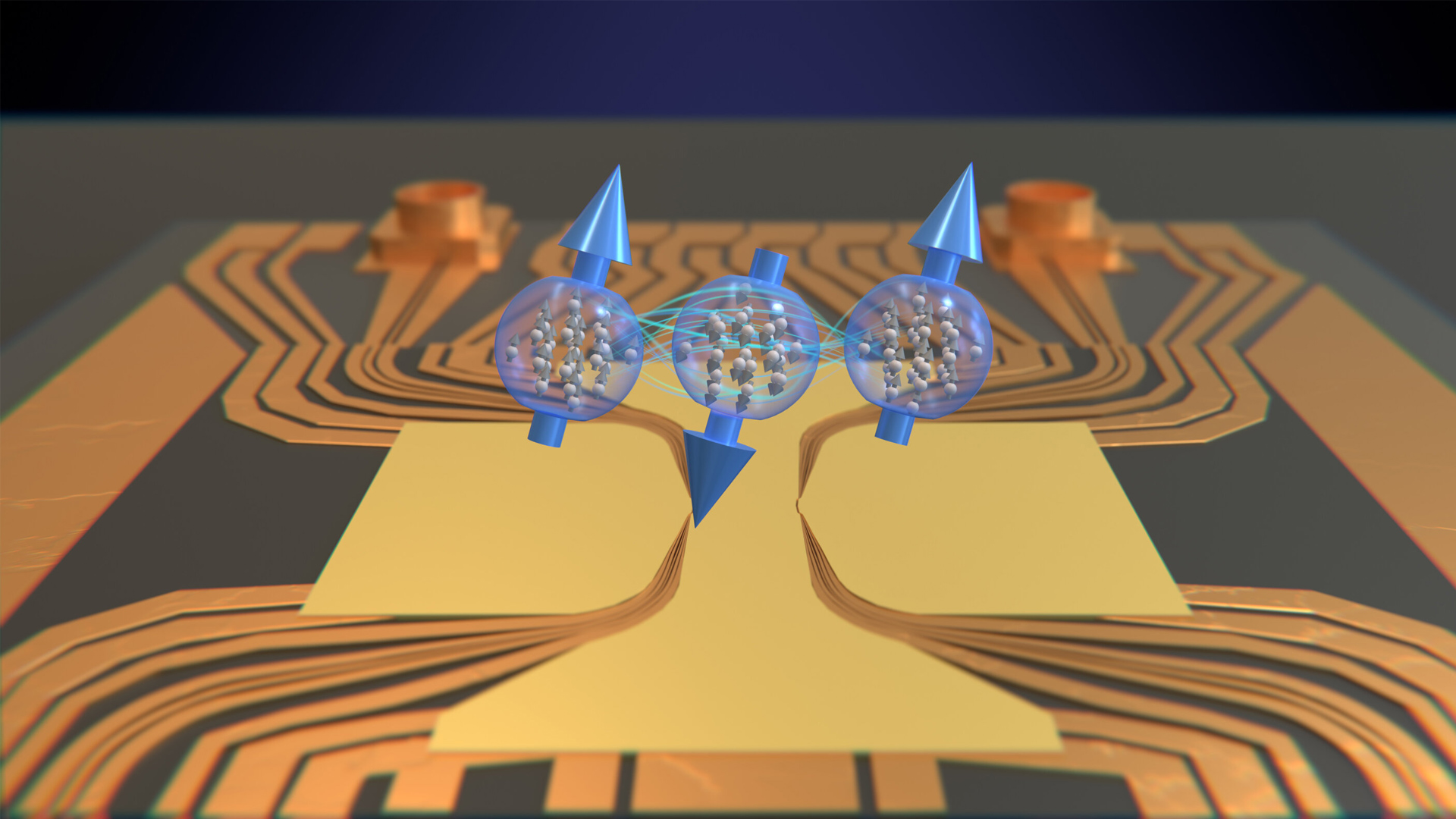
Recent research has unveiled a groundbreaking method to enhance measurement precision by utilizing quantum entanglement. Conducted by a team at the University of Basel, the study demonstrates how entangled atoms, when spatially separated, can provide sharper measurements of various physical quantities, including electromagnetic fields and gravity. This innovative approach could revolutionize the accuracy of some of the most advanced measuring instruments available today.
Traditionally, measuring entities at quantum scales is fraught with challenges due to intrinsic noise and uncertainty. Yifan Li, a postdoctoral researcher involved in the study, remarked, “So far, no one has performed such a quantum measurement with spatially separated entangled atomic clouds, and the theoretical framework for such measurements was also still unclear.” This research addresses these challenges by turning theoretical concepts into practical applications.
The experiment began with cooling atoms to extremely low temperatures, where quantum effects dominate their behavior. These atoms act as tiny magnets, with their spin direction changing in response to electromagnetic fields. Normally, measuring multiple atoms independently leads to random fluctuations that reduce accuracy. By employing quantum entanglement, where particles become correlated regardless of distance, the researchers were able to enhance measurement precision significantly.
In previous experiments, entanglement had been used effectively, but only when all atoms were located in the same physical space. This limitation restricted scientists to measuring a single point rather than observing variations across different locations. The breakthrough in this study involved a novel experimental technique that entangled the spins of a single cloud of ultracold atoms before separating them into distinct spatial locations. Remarkably, the entanglement persisted even after the separation, allowing the distant atomic clouds to behave as parts of a unified quantum system.
Philipp Treutlein, another author of the study and a professor at the University of Basel, explained the significance of this development: “We have now extended this concept by distributing the atoms into up to three spatially separated clouds. As a result, the effects of entanglement act at a distance, just as in the Einstein–Podolsky–Rosen (EPR) paradox.” This innovation enables each separated cloud to sense different segments of the electromagnetic field, allowing for a comprehensive understanding of how the field varies across space.
By synthesizing data from all locations, the researchers significantly reduced the usual quantum uncertainty that typically complicates measurements. The disturbances affecting each atom largely cancelled out due to their entangled state, leading to more reliable results. This work also established a theoretical framework outlining how uncertainty can be minimized by estimating multiple parameters simultaneously through spatially distributed entanglement.
The implications of this research are substantial, introducing a new type of quantum sensor that operates effectively across multiple locations while functioning cohesively as a single instrument. The technique could have immediate applications in advanced technologies, particularly with optical lattice clocks, which depend on the precise arrangement of numerous atoms to accurately keep time. By mitigating errors associated with atomic positioning, these clocks may achieve unprecedented levels of accuracy.
Additionally, the method holds promise for atom-based gravimeters, which are crucial for detecting variations in gravity across different regions rather than merely measuring its average strength. Despite the exciting prospects, the researchers acknowledge the technical challenges ahead. Maintaining the entangled state while managing multiple atomic clouds requires exceptional stability and precision. Advancing this method for broader applications will demand rigorous refinement and testing.
The findings from this research have been published in the March 2024 edition of the journal Science. The team plans to further develop their protocols and explore real-world applications in precision instruments, aiming to push the boundaries of measurement technology.

Philadelphia Parks Launch Free Earth Month Events Starting April 1

Bradford’s Fish Fry Fridays Serve Community with Delicious Dinners

Trump Faces Growing Challenges Amid Rising Tensions with Iran

Scientists Probe the Universe’s Missing Topological Defects

Samsung Galaxy Watch 9 to Feature Larger 435mAh Battery

UConn Huskies Aim to Defend Title in 2026 NCAA Women’s Tournament

U.S. Littoral Combat Ships Dock in Malaysia Amid Regional Tensions

Healthy Choice Wellness Reports Quarterly Earnings, Shares Rise

Urgent News: Charles M. Payment Passes Away at 78 in Duluth

University of Hawaiʻi Joins $25.6M AI Project to Enhance Disaster Monitoring

Major Grant Enhances Cancer Care and Research in Hawaiʻi

Joleen Chaney, Beloved Journalist, Passes Leaving Lasting Legacy

San Francisco’s SFO to Welcome 16 Airlines with Nonstop Flights to Europe in 2026

Goldman Sachs Unveils 2026 Catalyst Playbook for Biotech Investors

Discover Top Business Smartphones for Professionals in 2026

Urgent Update: Tom Aspinall’s Vision Deteriorates After UFC 321

Texas Roadhouse Honors Veterans with Free Meal Vouchers

CD Projekt Red Confirms No Release for The Witcher 4 in 2026
-
Science9 months ago
University of Hawaiʻi Joins $25.6M AI Project to Enhance Disaster Monitoring
-
 Health8 months ago
Major Grant Enhances Cancer Care and Research in Hawaiʻi
-
 Top Stories9 months ago
Joleen Chaney, Beloved Journalist, Passes Leaving Lasting Legacy
-
 World7 months ago
San Francisco’s SFO to Welcome 16 Airlines with Nonstop Flights to Europe in 2026
-
 Business8 months ago
Goldman Sachs Unveils 2026 Catalyst Playbook for Biotech Investors
-
 Business7 months ago
Discover Top Business Smartphones for Professionals in 2026
-
 Top Stories9 months ago
Urgent Update: Tom Aspinall’s Vision Deteriorates After UFC 321
-
 Lifestyle9 months ago
Texas Roadhouse Honors Veterans with Free Meal Vouchers
-
 Entertainment8 months ago
CD Projekt Red Confirms No Release for The Witcher 4 in 2026
-

 Top Stories10 months ago
AI Disruption: AWS Faces Threat as Startups Shift Cloud Focus
-

 Health10 months ago
MIT Scientists Uncover Surprising Genomic Loops During Cell Division
-

 Entertainment10 months ago
Discover the Full Map of Pokémon Legends: Z-A’s Lumiose City