
Science
Researchers Uncover How Gravitational Waves May Unravel Dark Matter

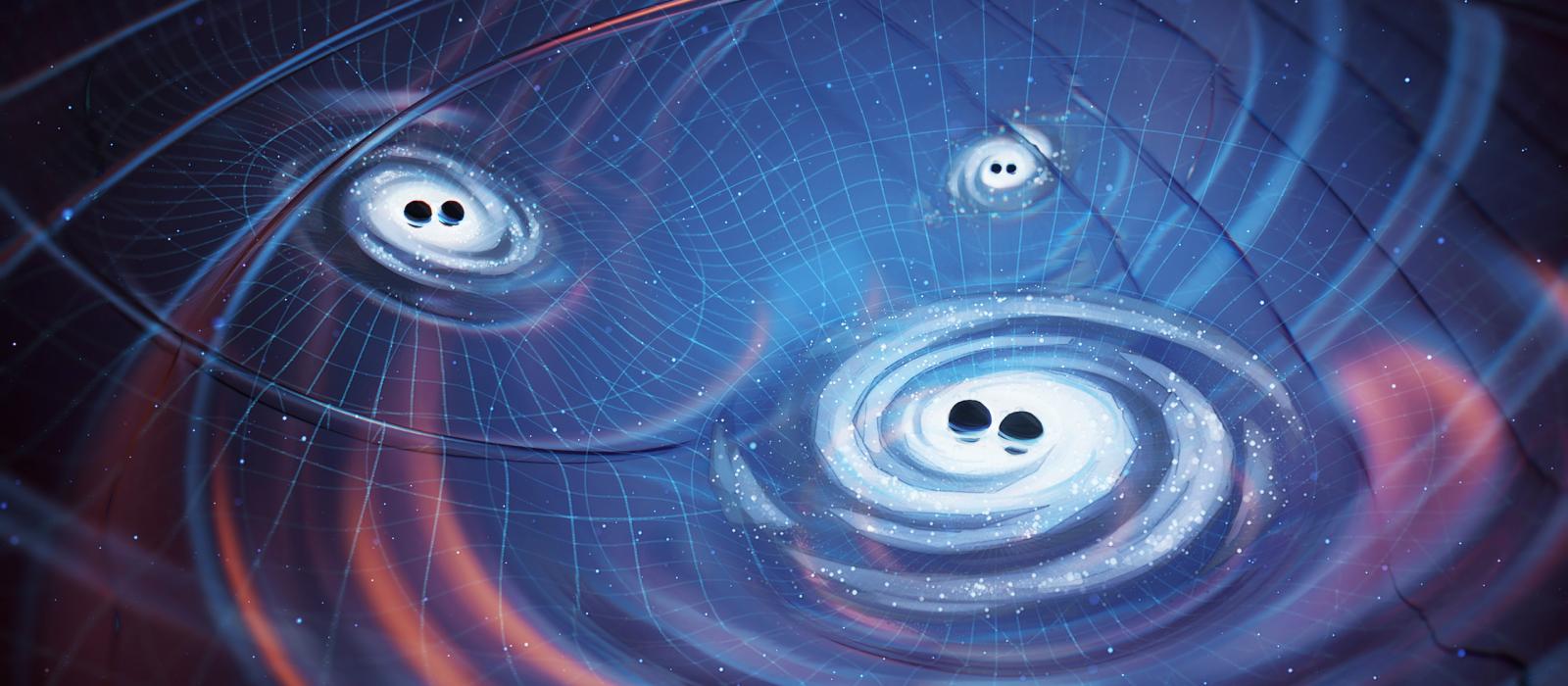
The University of Amsterdam has announced a groundbreaking study suggesting that gravitational waves (GWs) may provide crucial insights into dark matter, a mysterious substance believed to make up approximately 65% of the universe’s mass. Published in the journal Physical Review Letters, the research is a collaboration between the Institute of Physics (IoP) and the Gravitation & Astroparticle Physics Amsterdam (GRAPPA).
Gravitational waves were first detected in 2015, confirming a key prediction from Albert Einstein’s Theory of General Relativity. These waves are produced when massive objects, such as black holes and neutron stars, collide and merge, creating ripples in spacetime that can be detected across vast distances.
New Approaches to Understanding Dark Matter
Led by researchers Rodrigo Vicente, Theophanes K. Karydas, and Gianfranco Bertone, the study introduces a novel framework for modeling the interaction between gravitational waves and dark matter. The team focused on the dynamics of extreme mass-ratio inspirals (EMRIs), where black hole binaries or other compact objects like neutron stars orbit each other and spiral inward.
Unlike previous studies, which relied on simplified models, this new research employs General Relativity to account for the complex gravitational environments surrounding black holes. By incorporating a wide range of scenarios, the findings suggest that dense concentrations of dark matter could leave distinct signatures on gravitational wave signals.
The researchers specifically examined how dark matter “spikes” or “mounds” might affect the orbits of these merging black holes and the gravitational waves they produce. This marks a significant advancement in the field, as it provides the first fully relativistic approach to predicting gravitational wave emissions from black hole mergers.
Future Implications for Astronomy
The implications of this research extend beyond theoretical physics. The European Space Agency plans to launch the Laser Interferometer Space Antenna (LISA) within the next decade. This space-based observatory will be dedicated to studying gravitational waves and is expected to detect over 10,000 signals throughout its mission.
The findings from the University of Amsterdam will help prepare astronomers for the types of gravitational wave signals that LISA and other existing detectors, such as the Laser Interferometer Gravitational Wave Observatory (LIGO), the Virgo Collaboration, and the Kamioka Gravitational-wave Detector (KAGRA), may observe.
By harnessing gravitational waves to map dark matter distribution, scientists hope to gain a better understanding of this elusive substance and potentially uncover its fundamental nature and composition. As researchers continue to refine their models and methodologies, the study of gravitational waves stands poised to illuminate one of the universe’s most enduring mysteries.

Philadelphia Parks Launch Free Earth Month Events Starting April 1

Bradford’s Fish Fry Fridays Serve Community with Delicious Dinners

Trump Faces Growing Challenges Amid Rising Tensions with Iran

Scientists Probe the Universe’s Missing Topological Defects

Samsung Galaxy Watch 9 to Feature Larger 435mAh Battery

UConn Huskies Aim to Defend Title in 2026 NCAA Women’s Tournament

U.S. Littoral Combat Ships Dock in Malaysia Amid Regional Tensions

Healthy Choice Wellness Reports Quarterly Earnings, Shares Rise

Urgent News: Charles M. Payment Passes Away at 78 in Duluth

University of Hawaiʻi Joins $25.6M AI Project to Enhance Disaster Monitoring

Major Grant Enhances Cancer Care and Research in Hawaiʻi

Joleen Chaney, Beloved Journalist, Passes Leaving Lasting Legacy

San Francisco’s SFO to Welcome 16 Airlines with Nonstop Flights to Europe in 2026

Goldman Sachs Unveils 2026 Catalyst Playbook for Biotech Investors

Discover Top Business Smartphones for Professionals in 2026

Urgent Update: Tom Aspinall’s Vision Deteriorates After UFC 321

Texas Roadhouse Honors Veterans with Free Meal Vouchers

CD Projekt Red Confirms No Release for The Witcher 4 in 2026
-
Science9 months ago
University of Hawaiʻi Joins $25.6M AI Project to Enhance Disaster Monitoring
-
 Health8 months ago
Major Grant Enhances Cancer Care and Research in Hawaiʻi
-
 Top Stories9 months ago
Joleen Chaney, Beloved Journalist, Passes Leaving Lasting Legacy
-
 World7 months ago
San Francisco’s SFO to Welcome 16 Airlines with Nonstop Flights to Europe in 2026
-
 Business8 months ago
Goldman Sachs Unveils 2026 Catalyst Playbook for Biotech Investors
-
 Business7 months ago
Discover Top Business Smartphones for Professionals in 2026
-
 Top Stories9 months ago
Urgent Update: Tom Aspinall’s Vision Deteriorates After UFC 321
-
 Lifestyle9 months ago
Texas Roadhouse Honors Veterans with Free Meal Vouchers
-
 Entertainment8 months ago
CD Projekt Red Confirms No Release for The Witcher 4 in 2026
-

 Top Stories10 months ago
AI Disruption: AWS Faces Threat as Startups Shift Cloud Focus
-

 Health10 months ago
MIT Scientists Uncover Surprising Genomic Loops During Cell Division
-

 Entertainment10 months ago
Discover the Full Map of Pokémon Legends: Z-A’s Lumiose City