
Science
Scientists Investigate Mysterious Gamma Ray Glow in Milky Way

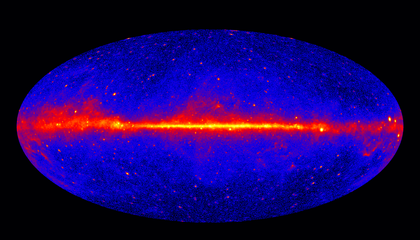
A recent discovery in the center of the Milky Way Galaxy has sparked excitement among scientists, as they investigate a significant excess of gamma rays. This phenomenon could potentially indicate the presence of dark matter particles, a long-sought component of the universe that remains elusive despite extensive research.
The excess gamma rays were first detected by the Fermi Gamma-ray Space Telescope, a collaborative project between NASA and the European Space Agency. Researchers observed an unusual glow emanating from the galactic core, which has led to speculation about its origins. While the data suggests a possible link to dark matter, experts caution that further analysis is required to draw definitive conclusions.
Dark matter, which is believed to make up approximately 27% of the universe, does not emit or interact with electromagnetic radiation, making it challenging to detect directly. Instead, its presence is inferred from gravitational effects on visible matter. The recent findings from the center of the Milky Way could represent a breakthrough in understanding this mysterious substance.
Examining the Data
Scientists have been analyzing the gamma rays for several years, and the results have raised intriguing questions. The concentration of gamma rays detected appears to exceed what would be expected from known astrophysical sources, such as pulsars or supernova remnants. This anomaly has led some researchers to propose that these gamma rays could be the result of dark matter annihilation—an interaction where dark matter particles collide and convert into gamma radiation.
Dr. Maria Bergström, a physicist at the University of Stockholm and a lead researcher on the project, stated, “Our findings open up new avenues for exploring dark matter. If these gamma rays are indeed from dark matter interactions, it would be a monumental step in particle physics and cosmology.”
While this theory is compelling, other explanations remain viable. The gamma rays might also stem from a previously unidentified population of pulsars, which are rapidly rotating neutron stars that emit beams of radiation. The complexity of the galactic center, with its dense star population and active black hole, makes it difficult to pinpoint the exact source of the gamma rays.
The Ongoing Search for Dark Matter
The quest to understand dark matter has persisted for decades, with various experiments and observations aimed at uncovering its nature. Researchers utilize advanced technologies like the Large Hadron Collider and various astronomical observatories to gather data that might provide insights into dark matter’s properties.
The results from the Fermi observations have reignited interest in the field, prompting scientists to design new experiments and observational campaigns. These efforts aim to confirm the origins of the gamma rays and enhance our understanding of dark matter.
As the scientific community continues to explore these intriguing findings, the possibility that the gamma ray glow could lead to a better understanding of dark matter remains tantalizing. The implications of such a discovery would be profound, potentially reshaping our comprehension of the universe and its fundamental components.
In summary, while the excess of gamma rays in the Milky Way presents an exciting opportunity to study dark matter, the path to clarity is fraught with challenges. Ongoing analysis and collaborative efforts among scientists worldwide will be essential in determining whether this phenomenon is indeed connected to dark matter or if alternative explanations hold sway. The search for answers continues, as researchers remain committed to unraveling one of the universe’s greatest mysteries.

Philadelphia Parks Launch Free Earth Month Events Starting April 1

Bradford’s Fish Fry Fridays Serve Community with Delicious Dinners

Trump Faces Growing Challenges Amid Rising Tensions with Iran

Scientists Probe the Universe’s Missing Topological Defects

Samsung Galaxy Watch 9 to Feature Larger 435mAh Battery

UConn Huskies Aim to Defend Title in 2026 NCAA Women’s Tournament

U.S. Littoral Combat Ships Dock in Malaysia Amid Regional Tensions

Healthy Choice Wellness Reports Quarterly Earnings, Shares Rise

Urgent News: Charles M. Payment Passes Away at 78 in Duluth

University of Hawaiʻi Joins $25.6M AI Project to Enhance Disaster Monitoring

Major Grant Enhances Cancer Care and Research in Hawaiʻi

Joleen Chaney, Beloved Journalist, Passes Leaving Lasting Legacy

San Francisco’s SFO to Welcome 16 Airlines with Nonstop Flights to Europe in 2026

Goldman Sachs Unveils 2026 Catalyst Playbook for Biotech Investors

Discover Top Business Smartphones for Professionals in 2026

Urgent Update: Tom Aspinall’s Vision Deteriorates After UFC 321

Texas Roadhouse Honors Veterans with Free Meal Vouchers

CD Projekt Red Confirms No Release for The Witcher 4 in 2026
-
Science9 months ago
University of Hawaiʻi Joins $25.6M AI Project to Enhance Disaster Monitoring
-
 Health8 months ago
Major Grant Enhances Cancer Care and Research in Hawaiʻi
-
 Top Stories9 months ago
Joleen Chaney, Beloved Journalist, Passes Leaving Lasting Legacy
-
 World7 months ago
San Francisco’s SFO to Welcome 16 Airlines with Nonstop Flights to Europe in 2026
-
 Business8 months ago
Goldman Sachs Unveils 2026 Catalyst Playbook for Biotech Investors
-
 Business7 months ago
Discover Top Business Smartphones for Professionals in 2026
-
 Top Stories9 months ago
Urgent Update: Tom Aspinall’s Vision Deteriorates After UFC 321
-
 Lifestyle9 months ago
Texas Roadhouse Honors Veterans with Free Meal Vouchers
-
 Entertainment8 months ago
CD Projekt Red Confirms No Release for The Witcher 4 in 2026
-

 Top Stories10 months ago
AI Disruption: AWS Faces Threat as Startups Shift Cloud Focus
-

 Health10 months ago
MIT Scientists Uncover Surprising Genomic Loops During Cell Division
-

 Entertainment10 months ago
Discover the Full Map of Pokémon Legends: Z-A’s Lumiose City