
Science
Scientists Unveil Unique Hybrid Framework for Enhanced Gas Separation

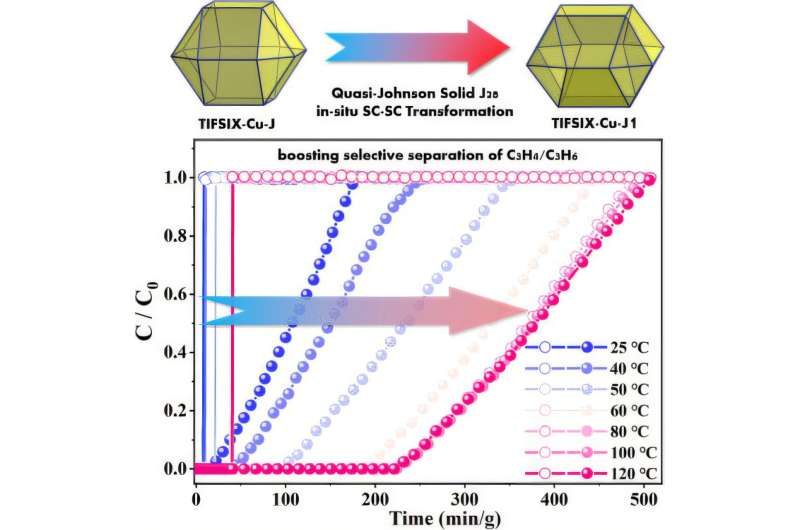
A research team led by Prof. Wu Mingyan from the Fujian Institute of Research on the Structure of Matter, part of the Chinese Academy of Sciences, has developed a novel hybrid porous framework designed to improve gas separation processes. The study, published on November 5, 2025, in the journal Chem, introduces the pillar-cage fluorinated hybrid framework known as TIFSIX-Cu-J, which features a rare quasi-Johnson solid J28 structure.
This innovative framework was synthesized using a bottom-up, self-assembly approach, incorporating geometrical elements of quadrangles and isosceles triangles. The team discovered that TIFSIX-Cu-J undergoes a significant heat-triggered structural transformation. During this process, the original J28 cage restructures into a distorted square orthobicupola structure, a change that was thoroughly analyzed through single-crystal-to-single-crystal (SC-SC) transformation and bulk crystalline powder X-ray diffraction.
Applications and Performance Metrics
The research highlights the practical applications of TIFSIX-Cu-J in gas separation. The framework demonstrated an impressive adsorption capacity for propylene (C3H4), reaching 140.5 cm³·g⁻¹. Notably, the differences in adsorption amounts between C3H4 and propene (C3H6) increased from 19.6 cm³·g⁻¹ to 34.8 cm³·g⁻¹. Furthermore, the selectivity of TIFSIX-Cu-J for C3H4/C3H6 improved significantly, indicating its potential effectiveness in industrial applications.
In practical tests, a packed column of TIFSIX-Cu-J achieved a production rate of C3H6 that was approximately twenty times greater than that of the previous structure. Theoretical calculations revealed that the optimal pore surface within the quasi-Johnson solid J28 cavity allows for preferential capture of C3H4, enhancing the selective separation process.
Implications for Future Research
This study not only advances the understanding of gas separation technologies but also opens new avenues for designing and synthesizing hybrid porous frameworks. The findings emphasize the efficacy of the bottom-up, self-assembly method in constructing artificial three-dimensional architectures with tailored separation properties.
By providing insights into the systematic design of these materials, the research could lead to significant improvements in energy-efficient gas purification processes. These advancements are particularly relevant as industries seek sustainable solutions for gas separation challenges.
For further details, see the full study by Cheng Chen et al, titled “Pillar-cage fluorinated hybrid porous frameworks featuring quasi-Johnson solid J28,” published in Chem. The DOI for the article is 10.1016/j.chempr.2025.102696.

Philadelphia Parks Launch Free Earth Month Events Starting April 1

Bradford’s Fish Fry Fridays Serve Community with Delicious Dinners

Trump Faces Growing Challenges Amid Rising Tensions with Iran

Scientists Probe the Universe’s Missing Topological Defects

Samsung Galaxy Watch 9 to Feature Larger 435mAh Battery

UConn Huskies Aim to Defend Title in 2026 NCAA Women’s Tournament

U.S. Littoral Combat Ships Dock in Malaysia Amid Regional Tensions

Healthy Choice Wellness Reports Quarterly Earnings, Shares Rise

Urgent News: Charles M. Payment Passes Away at 78 in Duluth

University of Hawaiʻi Joins $25.6M AI Project to Enhance Disaster Monitoring

Major Grant Enhances Cancer Care and Research in Hawaiʻi

Joleen Chaney, Beloved Journalist, Passes Leaving Lasting Legacy

San Francisco’s SFO to Welcome 16 Airlines with Nonstop Flights to Europe in 2026

Goldman Sachs Unveils 2026 Catalyst Playbook for Biotech Investors

Discover Top Business Smartphones for Professionals in 2026

Urgent Update: Tom Aspinall’s Vision Deteriorates After UFC 321

Texas Roadhouse Honors Veterans with Free Meal Vouchers

CD Projekt Red Confirms No Release for The Witcher 4 in 2026
-
Science9 months ago
University of Hawaiʻi Joins $25.6M AI Project to Enhance Disaster Monitoring
-
 Health8 months ago
Major Grant Enhances Cancer Care and Research in Hawaiʻi
-
 Top Stories9 months ago
Joleen Chaney, Beloved Journalist, Passes Leaving Lasting Legacy
-
 World7 months ago
San Francisco’s SFO to Welcome 16 Airlines with Nonstop Flights to Europe in 2026
-
 Business8 months ago
Goldman Sachs Unveils 2026 Catalyst Playbook for Biotech Investors
-
 Business8 months ago
Discover Top Business Smartphones for Professionals in 2026
-
 Top Stories9 months ago
Urgent Update: Tom Aspinall’s Vision Deteriorates After UFC 321
-
 Lifestyle9 months ago
Texas Roadhouse Honors Veterans with Free Meal Vouchers
-
 Entertainment8 months ago
CD Projekt Red Confirms No Release for The Witcher 4 in 2026
-

 Top Stories10 months ago
AI Disruption: AWS Faces Threat as Startups Shift Cloud Focus
-

 Health10 months ago
MIT Scientists Uncover Surprising Genomic Loops During Cell Division
-

 Entertainment10 months ago
Discover the Full Map of Pokémon Legends: Z-A’s Lumiose City