
Science
Study Reveals Cosmic Rays May Foster Earth-like Planets

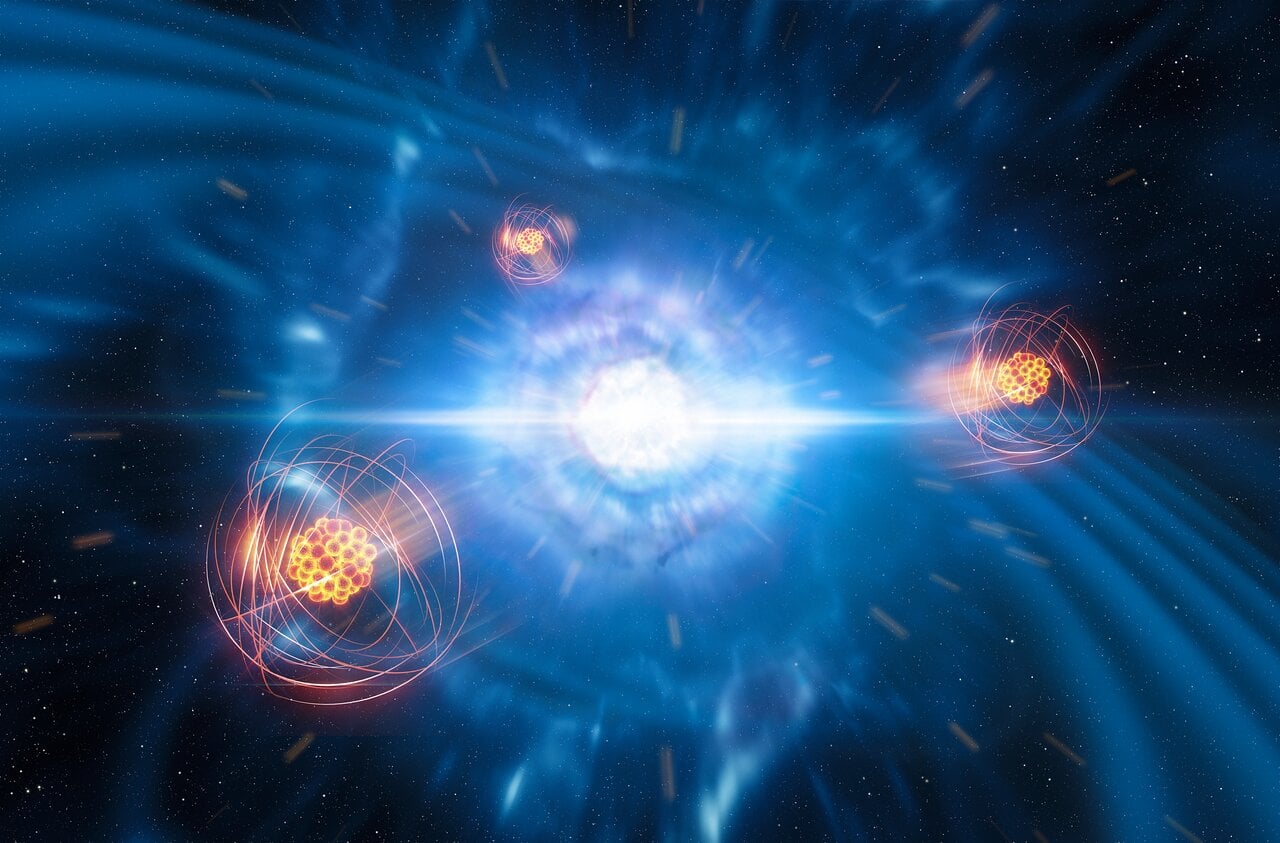
A recent study suggests that cosmic rays from distant supernovae may play a crucial role in the formation of Earth-like planets. Researchers, led by Ryo Sawada, propose that these cosmic rays could have enriched our solar system with short-lived radioisotopes (SLRs), essential for creating conditions favorable for terrestrial planets.
Creating an Earth-like world is no simple task. A planet must possess sufficient mass to retain an atmosphere and generate a protective magnetic field, all while being at a suitable distance from its star. This delicate balance ensures that a planet remains warm enough to support liquid water but not so hot that it loses this vital resource. Furthermore, the abundance of SLRs, which have half-lives of less than 5 million years, is critical. These isotopes, such as aluminum-26 and titanium-44, decay quickly, generating heat that can stabilize environments in young solar systems.
Evidence from meteorites indicates that our solar system was rich in SLRs, as seen by the presence of excess magnesium-26 derived from the decay of aluminum-26. The isotopes found in meteor fragments suggest that radioactive materials were abundant in the early solar system, contributing to the development of planets like Earth.
New Insights into Cosmic Enrichment
The prevailing theory regarding the formation of SLRs suggests they originate from supernovae. However, proximity to such explosive events poses challenges. If a supernova were to occur too close to a forming solar system, it could disrupt the protoplanetary disk, potentially hindering planet formation. This raises questions about how the Sun’s early disk remained intact during the tumultuous period of our solar system’s formation.
The new study challenges this notion by suggesting that rather than being directly impacted by a nearby supernova, the early solar system was instead bathed in cosmic rays emitted from a more distant supernova. The team’s model indicates that if at least one supernova occurred within a distance of one parsec, it could deliver a sufficient amount of cosmic rays to generate the necessary levels of radioactive isotopes comparable to those found in meteorites.
This theory implies that terrestrial planets like Earth could be more common than previously thought. Given that sun-like stars typically form within clusters, the likelihood of experiencing a supernova within a parsec is reasonably high.
Implications for Planetary Formation
The implications of this research are significant. Not only does it provide a plausible explanation for the presence of SLRs in our solar system, but it also suggests that the conditions for forming Earth-like planets may be more prevalent across the galaxy.
Moreover, the presence of aluminum-26 in the Milky Way can help estimate the average rate of supernovae, further supporting the idea that cosmic rays are a key component in the development of planets capable of supporting life.
This groundbreaking study, published in Science Advances, opens new avenues for understanding the processes that lead to planetary formation. As researchers continue to explore the intricacies of our cosmic neighborhood, the possibility of discovering more Earth-like planets seems increasingly within reach.
With further investigation, the findings may reshape our understanding of planetary systems and the potential for life beyond Earth. As the universe unfolds its secrets, the quest for knowledge about our origins continues to inspire both scientific inquiry and the imagination.

Philadelphia Parks Launch Free Earth Month Events Starting April 1

Bradford’s Fish Fry Fridays Serve Community with Delicious Dinners

Trump Faces Growing Challenges Amid Rising Tensions with Iran

Scientists Probe the Universe’s Missing Topological Defects

Samsung Galaxy Watch 9 to Feature Larger 435mAh Battery

UConn Huskies Aim to Defend Title in 2026 NCAA Women’s Tournament

U.S. Littoral Combat Ships Dock in Malaysia Amid Regional Tensions

Healthy Choice Wellness Reports Quarterly Earnings, Shares Rise

Urgent News: Charles M. Payment Passes Away at 78 in Duluth

University of Hawaiʻi Joins $25.6M AI Project to Enhance Disaster Monitoring

Major Grant Enhances Cancer Care and Research in Hawaiʻi

Joleen Chaney, Beloved Journalist, Passes Leaving Lasting Legacy

San Francisco’s SFO to Welcome 16 Airlines with Nonstop Flights to Europe in 2026

Goldman Sachs Unveils 2026 Catalyst Playbook for Biotech Investors

Discover Top Business Smartphones for Professionals in 2026

Urgent Update: Tom Aspinall’s Vision Deteriorates After UFC 321

Texas Roadhouse Honors Veterans with Free Meal Vouchers

CD Projekt Red Confirms No Release for The Witcher 4 in 2026
-
Science9 months ago
University of Hawaiʻi Joins $25.6M AI Project to Enhance Disaster Monitoring
-
 Health8 months ago
Major Grant Enhances Cancer Care and Research in Hawaiʻi
-
 Top Stories9 months ago
Joleen Chaney, Beloved Journalist, Passes Leaving Lasting Legacy
-
 World7 months ago
San Francisco’s SFO to Welcome 16 Airlines with Nonstop Flights to Europe in 2026
-
 Business8 months ago
Goldman Sachs Unveils 2026 Catalyst Playbook for Biotech Investors
-
 Business8 months ago
Discover Top Business Smartphones for Professionals in 2026
-
 Top Stories9 months ago
Urgent Update: Tom Aspinall’s Vision Deteriorates After UFC 321
-
 Lifestyle9 months ago
Texas Roadhouse Honors Veterans with Free Meal Vouchers
-
 Entertainment8 months ago
CD Projekt Red Confirms No Release for The Witcher 4 in 2026
-

 Top Stories10 months ago
AI Disruption: AWS Faces Threat as Startups Shift Cloud Focus
-

 Health10 months ago
MIT Scientists Uncover Surprising Genomic Loops During Cell Division
-

 Entertainment10 months ago
Discover the Full Map of Pokémon Legends: Z-A’s Lumiose City