
Science
Study Reveals Importance of Finger Counting in Early Math Skills

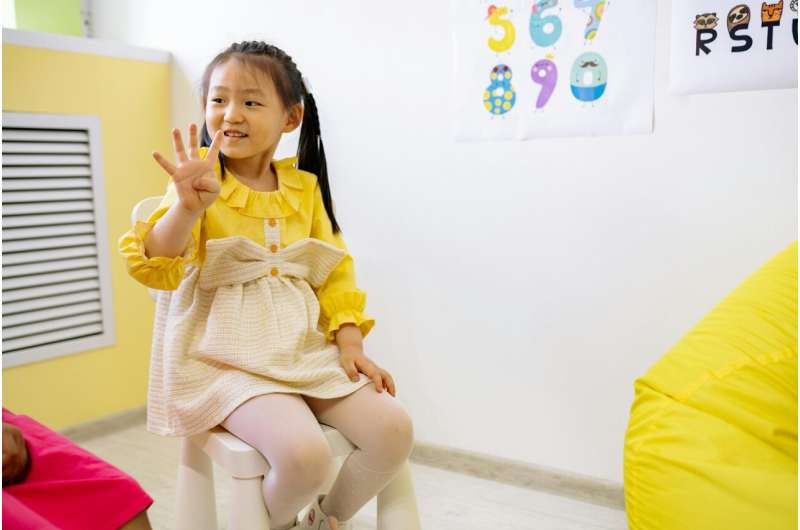
Children who engage in finger counting between the ages of 4 and 6.5 develop superior addition skills by age 7 compared to those who do not use this method, according to research published in the journal Developmental Psychology. This study, conducted by a team led by Catherine Thevenot, Ph.D., at the University of Lausanne in Switzerland, underscores the significance of finger counting as a foundational skill for mastering more complex mathematical concepts.
The study highlights that finger counting is a common strategy employed by young children to tackle arithmetic problems. Despite its benefits, many educators tend to discourage this practice early on. A French study noted that approximately 30% of first-grade teachers view finger counting as indicative of a child’s struggles with numerical understanding.
Research Methodology and Findings
Previous research primarily assessed children at a single point in time, showing that finger users performed better in arithmetic until around age 7. After this age, the trend reversed, with non-finger counters outperforming their peers. Thevenot and her colleague Marie Krenger, Ph.D., aimed to clarify whether non-finger users had never engaged in finger counting or were former users who had transitioned away from the method.
To explore this, the researchers tracked 211 Swiss children from ages 4.5 to 7.5, spanning pre-kindergarten to second grade. The children were tested biannually with progressively difficult addition problems, including tasks such as adding two digits between 1 and 5, and combinations of digits between 6 and 9. The researchers recorded whether the children used their fingers to solve the problems.
The data revealed that finger counting peaked between ages 5.5 and 6.5. Up to age 5, a majority of children tended to add without using their fingers. However, by age 6.5, 92% of children had utilized their fingers at least once during testing. By age 7.5, 43% of the participants had transitioned to being “ex-finger counters,” having previously used their fingers but no longer doing so, while 50% continued to rely on finger counting, and only 7% had never counted on their fingers.
Implications for Education
The study concluded that children who had previously used their fingers but had moved beyond this strategy tended to perform the best in arithmetic tasks. From age 6 onward, these former finger counters surpassed both those who had never used their fingers and those who still did.
Thevenot emphasized that the findings challenge the notion that finger counting should be discouraged in educational settings. She stated, “This research supports encouraging children to use their fingers in arithmetic without fear that they will become stuck in limited strategies.”
This study provides valuable insights into early childhood mathematics education and suggests that finger counting can be an essential tool for fostering advanced arithmetic skills. As educators reconsider their approaches, the evidence points towards a more supportive environment for young learners developing their numerical competencies.
More information can be found in the article titled “The Role of Children’s Finger Counting History on Their Addition Skills,” published in Developmental Psychology on November 20, 2025.

Philadelphia Parks Launch Free Earth Month Events Starting April 1

Bradford’s Fish Fry Fridays Serve Community with Delicious Dinners

Trump Faces Growing Challenges Amid Rising Tensions with Iran

Scientists Probe the Universe’s Missing Topological Defects

Samsung Galaxy Watch 9 to Feature Larger 435mAh Battery

UConn Huskies Aim to Defend Title in 2026 NCAA Women’s Tournament

U.S. Littoral Combat Ships Dock in Malaysia Amid Regional Tensions

Healthy Choice Wellness Reports Quarterly Earnings, Shares Rise

Urgent News: Charles M. Payment Passes Away at 78 in Duluth

University of Hawaiʻi Joins $25.6M AI Project to Enhance Disaster Monitoring

Major Grant Enhances Cancer Care and Research in Hawaiʻi

Joleen Chaney, Beloved Journalist, Passes Leaving Lasting Legacy

San Francisco’s SFO to Welcome 16 Airlines with Nonstop Flights to Europe in 2026

Goldman Sachs Unveils 2026 Catalyst Playbook for Biotech Investors

Discover Top Business Smartphones for Professionals in 2026

Urgent Update: Tom Aspinall’s Vision Deteriorates After UFC 321

Texas Roadhouse Honors Veterans with Free Meal Vouchers

CD Projekt Red Confirms No Release for The Witcher 4 in 2026
-
Science9 months ago
University of Hawaiʻi Joins $25.6M AI Project to Enhance Disaster Monitoring
-
 Health8 months ago
Major Grant Enhances Cancer Care and Research in Hawaiʻi
-
 Top Stories9 months ago
Joleen Chaney, Beloved Journalist, Passes Leaving Lasting Legacy
-
 World7 months ago
San Francisco’s SFO to Welcome 16 Airlines with Nonstop Flights to Europe in 2026
-
 Business8 months ago
Goldman Sachs Unveils 2026 Catalyst Playbook for Biotech Investors
-
 Business7 months ago
Discover Top Business Smartphones for Professionals in 2026
-
 Top Stories9 months ago
Urgent Update: Tom Aspinall’s Vision Deteriorates After UFC 321
-
 Lifestyle9 months ago
Texas Roadhouse Honors Veterans with Free Meal Vouchers
-
 Entertainment8 months ago
CD Projekt Red Confirms No Release for The Witcher 4 in 2026
-

 Top Stories10 months ago
AI Disruption: AWS Faces Threat as Startups Shift Cloud Focus
-

 Health10 months ago
MIT Scientists Uncover Surprising Genomic Loops During Cell Division
-

 Entertainment10 months ago
Discover the Full Map of Pokémon Legends: Z-A’s Lumiose City