
Science
Study Reveals New Insights Into Fuel Cell Catalysts’ Kinetics

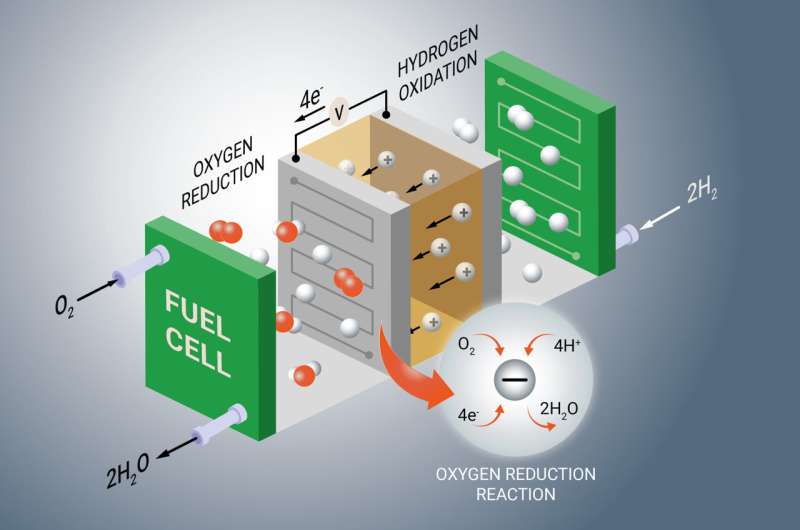
Researchers from the Fritz Haber Institute of the Max Planck Society have made significant advancements in understanding fuel cell catalysts, as detailed in their recent study published in Nature Communications. The findings reveal how different steps in the conversion of oxygen (O2) to water (H2O) affect catalyst kinetics, particularly how these processes are influenced by changes at the catalyst-solution interface.
The study represents a pivotal development in the field of multi-step electrocatalytic reactions. Catalysts are essential for future energy solutions, especially in fuel cells that can power heavy-duty and long-range vehicles. A deeper understanding of these catalysts is crucial for making this technology more viable for everyday applications.
Key Findings on Catalyst Kinetics
Conducted by Dr. Silva and Jody Druce under the guidance of Dr. Öner, the research investigates how variations in electrically applied overpotential and O2 pressure influence the kinetics of the oxygen reduction reaction (ORR) across four different catalysts in realistic fuel-cell environments. The team discovered a complex relationship between overpotential and catalyst activity, indicating that the activity is not limited to a single rate-determining step. Instead, various steps at the catalyst-solution interface change based on the overpotential applied.
Dr. Öner elaborated on the traditional perspective, stating, “The traditional view in the community is that multi-step reactions can be reduced to one rate-determining intermediate. However, our findings challenge this view.” The study indicates that both the rate-limiting steps and their control vary with overpotential and pressure, suggesting a need for a revised approach to electrocatalyst research.
A New Research Paradigm
The researchers propose a new kinetic framework that correlates with decades of observations from operando spectroscopy and microscopy. This framework aims to address how the dynamic, microscopic properties influenced by overpotential and pressure lead to the ensemble characteristics that define activation parameters.
Prof. Dr. Beatriz Roldán Cuenya emphasized the significance of linking chemical and structural changes at the catalyst-solution interface to activation parameters. “Our research not only advances our understanding of catalyst activity but also holds promise for enhancing energy conversion technologies,” she stated.
The team remains dedicated to further exploring these insights, which could have far-reaching implications for energy and chemical conversion technologies. By uncovering the intricate dynamics at play, they aim to pave the way for more efficient and effective catalytic systems in the future.
For more information, refer to the study titled “Pressure and bias dependence of the rate-limiting steps of the oxygen reduction reaction,” published in Nature Communications, DOI: 10.1038/s41467-025-67494-x.

Philadelphia Parks Launch Free Earth Month Events Starting April 1

Bradford’s Fish Fry Fridays Serve Community with Delicious Dinners

Trump Faces Growing Challenges Amid Rising Tensions with Iran

Scientists Probe the Universe’s Missing Topological Defects

Samsung Galaxy Watch 9 to Feature Larger 435mAh Battery

UConn Huskies Aim to Defend Title in 2026 NCAA Women’s Tournament

U.S. Littoral Combat Ships Dock in Malaysia Amid Regional Tensions

Healthy Choice Wellness Reports Quarterly Earnings, Shares Rise

Urgent News: Charles M. Payment Passes Away at 78 in Duluth

University of Hawaiʻi Joins $25.6M AI Project to Enhance Disaster Monitoring

Major Grant Enhances Cancer Care and Research in Hawaiʻi

Joleen Chaney, Beloved Journalist, Passes Leaving Lasting Legacy

San Francisco’s SFO to Welcome 16 Airlines with Nonstop Flights to Europe in 2026

Goldman Sachs Unveils 2026 Catalyst Playbook for Biotech Investors

Discover Top Business Smartphones for Professionals in 2026

Urgent Update: Tom Aspinall’s Vision Deteriorates After UFC 321

Texas Roadhouse Honors Veterans with Free Meal Vouchers

CD Projekt Red Confirms No Release for The Witcher 4 in 2026
-
Science9 months ago
University of Hawaiʻi Joins $25.6M AI Project to Enhance Disaster Monitoring
-
 Health8 months ago
Major Grant Enhances Cancer Care and Research in Hawaiʻi
-
 Top Stories9 months ago
Joleen Chaney, Beloved Journalist, Passes Leaving Lasting Legacy
-
 World7 months ago
San Francisco’s SFO to Welcome 16 Airlines with Nonstop Flights to Europe in 2026
-
 Business8 months ago
Goldman Sachs Unveils 2026 Catalyst Playbook for Biotech Investors
-
 Business8 months ago
Discover Top Business Smartphones for Professionals in 2026
-
 Top Stories9 months ago
Urgent Update: Tom Aspinall’s Vision Deteriorates After UFC 321
-
 Lifestyle9 months ago
Texas Roadhouse Honors Veterans with Free Meal Vouchers
-
 Entertainment8 months ago
CD Projekt Red Confirms No Release for The Witcher 4 in 2026
-

 Top Stories10 months ago
AI Disruption: AWS Faces Threat as Startups Shift Cloud Focus
-

 Health10 months ago
MIT Scientists Uncover Surprising Genomic Loops During Cell Division
-

 Entertainment10 months ago
Discover the Full Map of Pokémon Legends: Z-A’s Lumiose City