
Science
Trump Celebrates Space Force, Overlooks Artemis 2 in Address

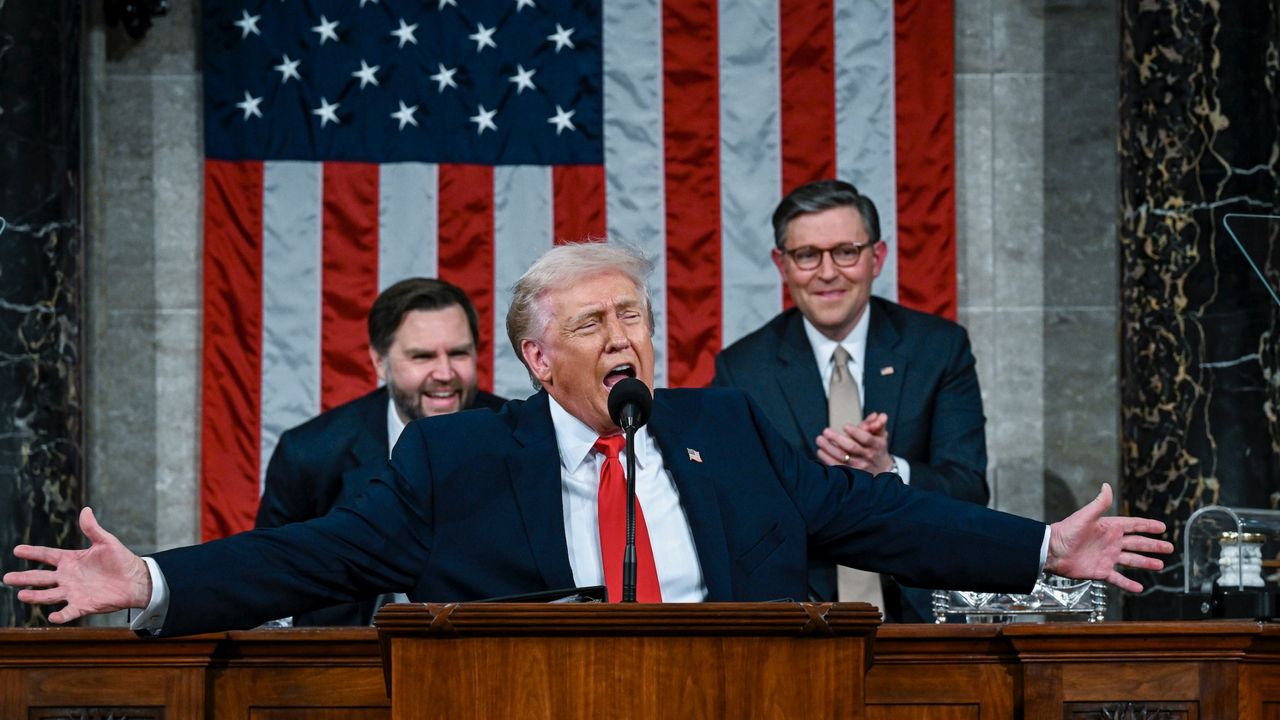
President Donald Trump delivered the longest State of the Union address in recorded history on February 24, 2024, lasting over 107 minutes. While the speech showcased the United States’ leadership on the global stage, it notably omitted a significant milestone: NASA’s upcoming Artemis 2 mission, which marks the nation’s first crewed lunar flight in more than 50 years.
The absence of any mention of Artemis 2 was striking, especially as the astronaut crew was present at the address. Trump spent considerable time praising the U.S. Space Force, a military branch he established in December 2019. He described it as “my baby,” emphasizing its growing importance in today’s military landscape. Trump stated, “This is a different fighting force than we had years ago, when we fought to tie. It’s a great fighting force. I’m so proud of it.”
In addition to the Space Force, Trump briefly touched on military operations, referencing the U.S. military’s recent actions in capturing Venezuelan President Nicolas Maduro. He indicated that the Space Force played a crucial role in this operation, known as Operation Absolute Resolve.
Despite the president’s enthusiastic comments about the Space Force, there was only one other reference to space during the lengthy address. Towards the end, Trump reflected on America’s achievements over its first 250 years, stating, “Americans lifted humanity into the skies on the wings of aluminum and steel, and then we launched mankind into the stars on rockets powered by sheer American will and unyielding American pride.”
The omission of Artemis 2 is particularly noteworthy given its significance. The mission is set to launch four astronauts around the moon as early as April 1, 2024. It represents the first crewed flight beyond low Earth orbit since Apollo 17 in 1972. Among the Artemis 2 crew are NASA‘s Reid Wiseman, Victor Glover, and Christina Koch, along with Jeremy Hansen of the Canadian Space Agency.
The Artemis program, aimed at establishing a sustainable human presence on the moon, was initiated in December 2017 during Trump’s first term. He had previously expressed a desire for Artemis astronauts to land on the moon by late 2024, aligning with what he envisioned as the conclusion of his second term. However, the program has faced numerous delays, including a recent setback announced just days before the State of the Union address.
NASA had aimed to launch Artemis 2 on March 6, 2024, but a glitch with the mission’s Space Launch System rocket necessitated troubleshooting, pushing the launch date to April 1 at the earliest. The Artemis crew had just entered quarantine on February 21 in preparation for the flight but left quarantine a day later, only to have their mission timeline altered.
While the Artemis 2 astronauts attended the State of the Union as guests of Mike Johnson, the Speaker of the House of Representatives, they received minimal visibility during the televised event. U.S. Senator Mark Kelly from Arizona, a former NASA astronaut, was the only space figure featured prominently in the broadcast. The Trump administration has recently faced criticism for censuring Kelly over his participation in a video encouraging U.S. servicemembers to resist illegal orders.
In contrast, last year’s State of the Union address had a more pronounced focus on space exploration. Trump had stated that Americans would “pursue our manifest destiny into the stars,” aiming to send astronauts to Mars. The stark difference in focus this year raises questions about the administration’s current priorities in space policy and exploration.
As the Artemis 2 mission approaches, the space community watches closely, hoping for renewed emphasis on American space exploration efforts and a commitment to advancing initiatives that inspire future generations.

Philadelphia Parks Launch Free Earth Month Events Starting April 1

Bradford’s Fish Fry Fridays Serve Community with Delicious Dinners

Trump Faces Growing Challenges Amid Rising Tensions with Iran

Scientists Probe the Universe’s Missing Topological Defects

Samsung Galaxy Watch 9 to Feature Larger 435mAh Battery

UConn Huskies Aim to Defend Title in 2026 NCAA Women’s Tournament

U.S. Littoral Combat Ships Dock in Malaysia Amid Regional Tensions

Healthy Choice Wellness Reports Quarterly Earnings, Shares Rise

Urgent News: Charles M. Payment Passes Away at 78 in Duluth

University of Hawaiʻi Joins $25.6M AI Project to Enhance Disaster Monitoring

Major Grant Enhances Cancer Care and Research in Hawaiʻi

Joleen Chaney, Beloved Journalist, Passes Leaving Lasting Legacy

San Francisco’s SFO to Welcome 16 Airlines with Nonstop Flights to Europe in 2026

Goldman Sachs Unveils 2026 Catalyst Playbook for Biotech Investors

Discover Top Business Smartphones for Professionals in 2026

Urgent Update: Tom Aspinall’s Vision Deteriorates After UFC 321

Texas Roadhouse Honors Veterans with Free Meal Vouchers

CD Projekt Red Confirms No Release for The Witcher 4 in 2026
-
Science9 months ago
University of Hawaiʻi Joins $25.6M AI Project to Enhance Disaster Monitoring
-
 Health8 months ago
Major Grant Enhances Cancer Care and Research in Hawaiʻi
-
 Top Stories9 months ago
Joleen Chaney, Beloved Journalist, Passes Leaving Lasting Legacy
-
 World7 months ago
San Francisco’s SFO to Welcome 16 Airlines with Nonstop Flights to Europe in 2026
-
 Business8 months ago
Goldman Sachs Unveils 2026 Catalyst Playbook for Biotech Investors
-
 Business7 months ago
Discover Top Business Smartphones for Professionals in 2026
-
 Top Stories9 months ago
Urgent Update: Tom Aspinall’s Vision Deteriorates After UFC 321
-
 Lifestyle9 months ago
Texas Roadhouse Honors Veterans with Free Meal Vouchers
-
 Entertainment8 months ago
CD Projekt Red Confirms No Release for The Witcher 4 in 2026
-

 Top Stories10 months ago
AI Disruption: AWS Faces Threat as Startups Shift Cloud Focus
-

 Health10 months ago
MIT Scientists Uncover Surprising Genomic Loops During Cell Division
-

 Entertainment10 months ago
Discover the Full Map of Pokémon Legends: Z-A’s Lumiose City