
Science
New Antibody 77A Enhances Immune Response Against Cancer

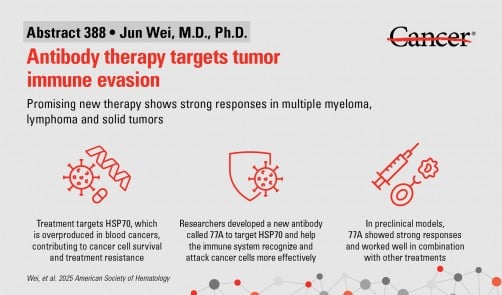
In a significant advancement in cancer treatment, researchers from The University of Texas MD Anderson Cancer Center have developed an investigational antibody therapy named 77A. This new therapy demonstrates potential in enhancing immune responses against various blood cancers, including myeloma and lymphoma, as well as solid tumors. The findings were presented on December 6, 2025, at the 67th American Society of Hematology (ASH) Annual Meeting.
Understanding the Mechanism of 77A
Led by Jun Wei, M.D., Ph.D., an assistant professor of Lymphoma & Myeloma, and principal investigator Robert Z. Orlowski, M.D., Ph.D., the study explores how 77A targets a protein known as HSP70. This heat shock protein is often overproduced in many tumors, allowing them to evade the immune system by fostering a suppressive tumor environment.
By targeting HSP70, the 77A antibody activates T cells and natural killer (NK) cells, crucial components of the immune system. In laboratory models, it not only enhanced the effectiveness of chemotherapy and radiation but also boosted the efficacy of immunotherapies across multiple tumor types. Notably, the antibody shows promise in improving immune cell responses against cancer, indicating a potential pathway to more effective immunotherapy treatments.
Next Steps and Future Implications
The encouraging results from laboratory tests highlight the ability of 77A to overcome treatment resistance that many patients experience with existing therapies. Early tests involving human immune cells indicate that 77A could enhance immune responses in healthy individuals, suggesting its versatility as a therapeutic option.
Orlowski stated, “These results give us confidence that 77A could become a versatile immunotherapy.” The research team plans to advance a humanized version of the antibody into clinical trials, aiming to evaluate its effectiveness in patients with various cancer types. With support from Blood Cancer United, formerly known as the Leukemia & Lymphoma Society, the development of 77A is set to progress, potentially offering new hope to patients facing challenging diagnoses.
The study represents a significant step forward in cancer research and immunotherapy, providing a foundation for future clinical applications of the 77A antibody. Further exploration into its capabilities will be crucial in determining its role in changing the landscape of cancer treatment.

Philadelphia Parks Launch Free Earth Month Events Starting April 1

Bradford’s Fish Fry Fridays Serve Community with Delicious Dinners

Trump Faces Growing Challenges Amid Rising Tensions with Iran

Scientists Probe the Universe’s Missing Topological Defects

Samsung Galaxy Watch 9 to Feature Larger 435mAh Battery

UConn Huskies Aim to Defend Title in 2026 NCAA Women’s Tournament

U.S. Littoral Combat Ships Dock in Malaysia Amid Regional Tensions

Healthy Choice Wellness Reports Quarterly Earnings, Shares Rise

Urgent News: Charles M. Payment Passes Away at 78 in Duluth

University of Hawaiʻi Joins $25.6M AI Project to Enhance Disaster Monitoring

Major Grant Enhances Cancer Care and Research in Hawaiʻi

Joleen Chaney, Beloved Journalist, Passes Leaving Lasting Legacy

San Francisco’s SFO to Welcome 16 Airlines with Nonstop Flights to Europe in 2026

Goldman Sachs Unveils 2026 Catalyst Playbook for Biotech Investors

Discover Top Business Smartphones for Professionals in 2026

Urgent Update: Tom Aspinall’s Vision Deteriorates After UFC 321

Texas Roadhouse Honors Veterans with Free Meal Vouchers

CD Projekt Red Confirms No Release for The Witcher 4 in 2026
-
Science9 months ago
University of Hawaiʻi Joins $25.6M AI Project to Enhance Disaster Monitoring
-
 Health8 months ago
Major Grant Enhances Cancer Care and Research in Hawaiʻi
-
 Top Stories9 months ago
Joleen Chaney, Beloved Journalist, Passes Leaving Lasting Legacy
-
 World7 months ago
San Francisco’s SFO to Welcome 16 Airlines with Nonstop Flights to Europe in 2026
-
 Business8 months ago
Goldman Sachs Unveils 2026 Catalyst Playbook for Biotech Investors
-
 Business8 months ago
Discover Top Business Smartphones for Professionals in 2026
-
 Top Stories9 months ago
Urgent Update: Tom Aspinall’s Vision Deteriorates After UFC 321
-
 Lifestyle9 months ago
Texas Roadhouse Honors Veterans with Free Meal Vouchers
-
 Entertainment8 months ago
CD Projekt Red Confirms No Release for The Witcher 4 in 2026
-

 Top Stories10 months ago
AI Disruption: AWS Faces Threat as Startups Shift Cloud Focus
-

 Health10 months ago
MIT Scientists Uncover Surprising Genomic Loops During Cell Division
-

 Entertainment10 months ago
Discover the Full Map of Pokémon Legends: Z-A’s Lumiose City