
Politics
NGA Withdraws from White House Meeting After Trump Excludes Governors

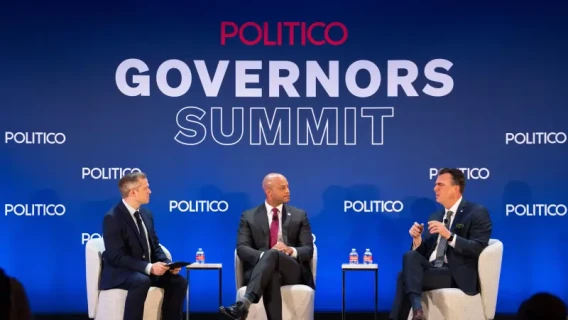
The National Governors Association (NGA) has decided to withdraw from an annual meeting at the White House following President Donald Trump‘s exclusion of two Democratic governors from the invitation list. This development undermines one of the few remaining bipartisan gatherings in Washington, D.C. Although Trump will still meet with the governors on March 15, 2024, the event will no longer be facilitated by the NGA, an organization established more than a century ago to support state leaders from both parties in advocating for their interests.
The situation escalated when Trump did not invite Governor Jared Polis of Colorado and Governor Wes Moore of Maryland, branding them as “not worthy of being there” on social media. In a brief interview, Polis expressed his inability to understand Trump’s rationale, stating, “I’ve spent quality time with my colleagues this morning and really learning from one another.” He emphasized the importance of sharing best practices irrespective of party affiliations.
This incident highlights Trump’s confrontational approach towards state leaders he perceives unfavorably. Throughout his second term, he has not hesitated to threaten to withhold federal funds or deploy troops in response to local dissent. The withdrawal of the NGA from the White House meeting indicates a significant shift in the dynamics between state and federal leadership, particularly in light of Trump’s reluctance to foster unity within the country.
In remarks made during a Politico event, Governor Spencer Cox of Utah, a Republican, acknowledged Trump’s lack of focus on national unity, stating, “He’s not putting his mind to it. He’s said very clearly that that’s not who he is.” Meanwhile, Moore conveyed his desire to avoid conflict with the president, commenting, “I didn’t run for governor like, man, I can’t wait so me and the president can go toe to toe.” He expressed concern for Trump, suggesting that constant public scrutiny might be burdensome for the president.
The dynamics of the meeting were starkly different from the atmosphere of bipartisanship that both Moore and Oklahoma Governor Kevin Stitt, the NGA chair, aimed to promote. They were seen sharing humorous exchanges and mutual respect during the week’s events. Stitt commended Moore, stating, “He is a great American, loves his country, and is just trying to do the best he can for Maryland.”
Despite attempts to mediate the situation, Stitt faced backlash from Trump, who labeled him a “RINO,” or Republican In Name Only. Yet, Stitt maintained a conciliatory tone, suggesting that politics can take a toll on leaders, remarking, “I can’t imagine being president of the United States. He’s got a tough job to do.”
Former Maryland Governor Larry Hogan, a Republican who has occasionally clashed with Trump, criticized the White House for not including all governors. He noted, “It was a nice thing annually to bring all the governors—Republicans and Democrats—together.” Hogan argued that collaboration, even amidst disagreements, would benefit all parties involved.
Beyond the White House meeting, several governors voiced their concerns regarding the growing power of the administration. They lamented the inaction of the Republican-controlled Congress to check Trump’s ambitions and positioned themselves as essential counterweights to executive authority. Cox stated, “Congress needs to get their act together. And stop performing for TikTok and actually start doing stuff.”
As discussions unfolded, speculation arose about which governors might enter the presidential race in 2028. Moore and Governor Josh Shapiro of Pennsylvania were among those considered potential Democratic candidates, while others such as Governors Gavin Newsom of California and J.B. Pritzker of Illinois were absent from the gathering. Both Stitt and Moore refrained from ruling out future presidential bids, maintaining their focus on their respective states.
Governor Andy Beshear of Kentucky took a more open approach, recently announcing his plans to publish a book. He addressed questions about a potential presidential campaign during a Center for American Progress event, indicating that he would consider his options after prioritizing Kentucky’s needs.
The withdrawal of the NGA from the White House meeting serves as a stark reminder of the ongoing tensions in American politics, particularly the challenges of fostering bipartisan dialogue in an increasingly polarized landscape.

Philadelphia Parks Launch Free Earth Month Events Starting April 1

Bradford’s Fish Fry Fridays Serve Community with Delicious Dinners

Trump Faces Growing Challenges Amid Rising Tensions with Iran

Scientists Probe the Universe’s Missing Topological Defects

Samsung Galaxy Watch 9 to Feature Larger 435mAh Battery

UConn Huskies Aim to Defend Title in 2026 NCAA Women’s Tournament

U.S. Littoral Combat Ships Dock in Malaysia Amid Regional Tensions

Healthy Choice Wellness Reports Quarterly Earnings, Shares Rise

Urgent News: Charles M. Payment Passes Away at 78 in Duluth

University of Hawaiʻi Joins $25.6M AI Project to Enhance Disaster Monitoring

Major Grant Enhances Cancer Care and Research in Hawaiʻi

Joleen Chaney, Beloved Journalist, Passes Leaving Lasting Legacy

San Francisco’s SFO to Welcome 16 Airlines with Nonstop Flights to Europe in 2026

Goldman Sachs Unveils 2026 Catalyst Playbook for Biotech Investors

Discover Top Business Smartphones for Professionals in 2026

Urgent Update: Tom Aspinall’s Vision Deteriorates After UFC 321

Texas Roadhouse Honors Veterans with Free Meal Vouchers

CD Projekt Red Confirms No Release for The Witcher 4 in 2026
-
Science9 months ago
University of Hawaiʻi Joins $25.6M AI Project to Enhance Disaster Monitoring
-
 Health8 months ago
Major Grant Enhances Cancer Care and Research in Hawaiʻi
-
 Top Stories9 months ago
Joleen Chaney, Beloved Journalist, Passes Leaving Lasting Legacy
-
 World7 months ago
San Francisco’s SFO to Welcome 16 Airlines with Nonstop Flights to Europe in 2026
-
 Business8 months ago
Goldman Sachs Unveils 2026 Catalyst Playbook for Biotech Investors
-
 Business7 months ago
Discover Top Business Smartphones for Professionals in 2026
-
 Top Stories9 months ago
Urgent Update: Tom Aspinall’s Vision Deteriorates After UFC 321
-
 Lifestyle9 months ago
Texas Roadhouse Honors Veterans with Free Meal Vouchers
-
 Entertainment8 months ago
CD Projekt Red Confirms No Release for The Witcher 4 in 2026
-

 Top Stories10 months ago
AI Disruption: AWS Faces Threat as Startups Shift Cloud Focus
-

 Health10 months ago
MIT Scientists Uncover Surprising Genomic Loops During Cell Division
-

 Entertainment10 months ago
Discover the Full Map of Pokémon Legends: Z-A’s Lumiose City