
Science
Archaeologists Uncover Possible Remains of Noah’s Ark in Turkey

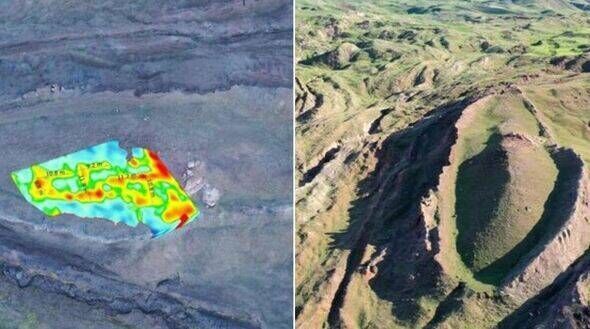
Archaeologists have made a significant discovery in Turkey that could potentially be linked to the biblical Noah’s Ark. Utilizing advanced Ground Penetrating Radar (GPR) technology, a research team has identified what they believe to be remnants of the legendary vessel, located near the Durupinar Formation, approximately 18 miles south of Mount Ararat.
The analysis revealed a “chemical imprint,” along with “pieces of wood” and the outline of a large hall, suggesting the presence of a structure consistent with the description of Noah’s Ark. According to the biblical account, this massive boat saved humanity and various animal species from a catastrophic flood over 4,300 years ago.
Details from Ground Penetrating Radar Analysis
The American research team, which includes independent researcher Andrew Jones from Noah’s Ark Scans, has detected angular formations and a hollow space deep within the mountain. GPR scans indicated a corridor approximately 13 feet wide slicing through the core of the formation. The team observed what they believe to be walkways or hallways consistent with the biblical description of the ark, as reported by the Express UK.
The scans uncovered three distinct layers beneath the surface, aligning with the biblical narrative of the ark having three decks. Genesis 6:16 states: “Make a roof for the ark, and finish it to a cubit above, and set the door of the ark in its side. Make it with lower, second, and third decks,” lending credence to their findings.
In an interview with the Christian Broadcasting Network (CBN), Jones commented on the nature of the discovery, stating, “We’re not expecting something that’s fully preserved. What’s left is the chemical imprint, pieces of wood in the ground, and the shape of a hall.”
Historical Context and Ongoing Research
The Durupinar Formation has only been known to modern archaeology for less than a century, with significant interest sparked after heavy rains and earthquakes in May 1948 exposed the formation. This area is steeped in biblical history, as the accounts indicate that Noah’s Ark came to rest on the “mountains of Ararat” following a flood that lasted 150 days.
The formation’s dimensions closely resemble those described in sacred texts, which specify the ark as being “300 cubits long, 50 cubits wide, and 30 cubits high”—approximately 515 feet long, 86 feet wide, and 52 feet tall. The theory that the ark landed on Mount Ararat has been a topic of debate, with some scholars arguing it is merely a natural rock structure while others maintain it points to a far more significant finding.
Jones and his team are committed to further investigation. Their GPR findings suggest additional structures extending up to 20 feet below the surface, which could indicate compartments consistent with a man-made vessel. “This is not what you’d expect to see if the site were simply a solid block of rock or random mudflow debris,” Jones emphasized.
The research team also conducted soil analysis, leading to intriguing results. Jones noted that the grass in the boat-shaped formation exhibited a different color compared to surrounding areas, which might indicate human construction rather than natural formation.
Fellow researcher William Crabtree mentioned that a passageway appears to extend from the formation’s tip toward its center, spacious enough for an individual to walk through. Soil tests revealed that the concentration of organic matter within the formation was double that of the adjacent earth. Crabtree explained, “If this was a wooden boat and the wood had rotted over time, we would expect to see elevated levels of potassium, changes in pH, and higher organic content—and that’s exactly what we’re finding.”
The team plans to expand their soil testing efforts beyond the 22 specimens already collected. They are also preparing for core drilling and additional GPR surveys throughout the site. “We want to compare what’s inside the formation to what’s outside,” Jones stated. “That could give us a much clearer picture of whether this is truly something man-made.”
As the research progresses, the findings at the Durupinar Formation continue to draw interest and scrutiny, potentially shedding new light on one of history’s most enduring stories.

Philadelphia Parks Launch Free Earth Month Events Starting April 1

Bradford’s Fish Fry Fridays Serve Community with Delicious Dinners

Trump Faces Growing Challenges Amid Rising Tensions with Iran

Scientists Probe the Universe’s Missing Topological Defects

Samsung Galaxy Watch 9 to Feature Larger 435mAh Battery

UConn Huskies Aim to Defend Title in 2026 NCAA Women’s Tournament

U.S. Littoral Combat Ships Dock in Malaysia Amid Regional Tensions

Healthy Choice Wellness Reports Quarterly Earnings, Shares Rise

Urgent News: Charles M. Payment Passes Away at 78 in Duluth

University of Hawaiʻi Joins $25.6M AI Project to Enhance Disaster Monitoring

Major Grant Enhances Cancer Care and Research in Hawaiʻi

Joleen Chaney, Beloved Journalist, Passes Leaving Lasting Legacy

San Francisco’s SFO to Welcome 16 Airlines with Nonstop Flights to Europe in 2026

Goldman Sachs Unveils 2026 Catalyst Playbook for Biotech Investors

Discover Top Business Smartphones for Professionals in 2026

Urgent Update: Tom Aspinall’s Vision Deteriorates After UFC 321

Texas Roadhouse Honors Veterans with Free Meal Vouchers

CD Projekt Red Confirms No Release for The Witcher 4 in 2026
-
Science9 months ago
University of Hawaiʻi Joins $25.6M AI Project to Enhance Disaster Monitoring
-
 Health8 months ago
Major Grant Enhances Cancer Care and Research in Hawaiʻi
-
 Top Stories9 months ago
Joleen Chaney, Beloved Journalist, Passes Leaving Lasting Legacy
-
 World7 months ago
San Francisco’s SFO to Welcome 16 Airlines with Nonstop Flights to Europe in 2026
-
 Business8 months ago
Goldman Sachs Unveils 2026 Catalyst Playbook for Biotech Investors
-
 Business8 months ago
Discover Top Business Smartphones for Professionals in 2026
-
 Top Stories9 months ago
Urgent Update: Tom Aspinall’s Vision Deteriorates After UFC 321
-
 Lifestyle9 months ago
Texas Roadhouse Honors Veterans with Free Meal Vouchers
-
 Entertainment8 months ago
CD Projekt Red Confirms No Release for The Witcher 4 in 2026
-

 Top Stories10 months ago
AI Disruption: AWS Faces Threat as Startups Shift Cloud Focus
-

 Health10 months ago
MIT Scientists Uncover Surprising Genomic Loops During Cell Division
-

 Entertainment10 months ago
Discover the Full Map of Pokémon Legends: Z-A’s Lumiose City