
Science
Astronomers Discover Evidence of Early “Monster Stars” in Universe

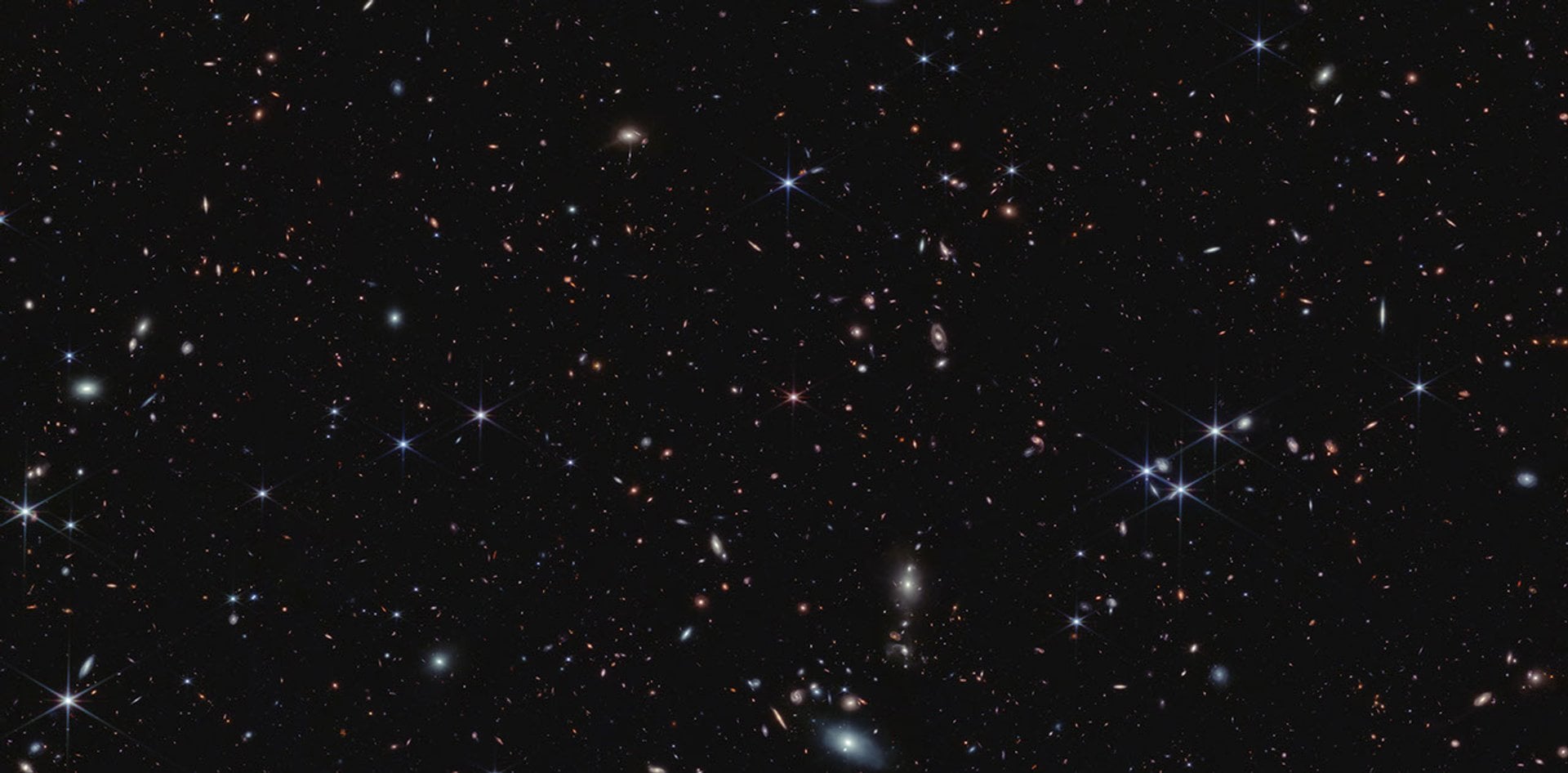
Astronomers have uncovered significant evidence suggesting the existence of “monster stars,” which are believed to have formed in the early Universe. Utilizing the advanced capabilities of the James Webb Space Telescope (JWST), a collaborative team of researchers has provided insights into how supermassive black holes (SMBHs) may have originated shortly after the Big Bang. This discovery has the potential to reshape our understanding of cosmic evolution during the Universe’s formative years.
For over two decades, the formation of SMBHs—massive entities weighing millions to billions of solar masses—has puzzled scientists. Traditional cosmological models indicate that these black holes could not have developed through standard processes in the limited timeframe available post-Big Bang. Recent findings challenge these models, suggesting instead that “seeds” of SMBHs could have emerged directly from collapsing clouds of cosmic gas, known as direct collapse black holes (DCBHs). Another possibility considered is that massive early stars, referred to as Population III stars, could have existed, providing remnants that ultimately formed gigantic black holes.
Leading this research, Devesh Nandal, a Postdoctoral Fellow at the University of Virginia and the Institute for Theory and Computation at the Harvard & Smithsonian Center for Astrophysics, along with a diverse team including Daniel Whalen from the University of Portsmouth, Muhammad A. Latif from United Arab Emirates University, and Alexander Heger from Monash University, have recently published their findings.
Investigating Galaxy GS 3073
The team focused on the galaxy GS 3073, previously identified in 2022, which exhibited an unusual nitrogen-to-oxygen ratio of 0.46. This ratio is significantly higher than what is observed in known stellar types and explosions, suggesting unique stellar evolution processes. Their investigation indicates that this galaxy contains an actively feeding black hole at its center, which may be a remnant of one of these hypothesized monster stars. The presence of such stars would help clarify the detection of multiple quasars observed by JWST that existed less than one billion years after the Big Bang.
Quasars, also known as Active Galactic Nuclei (AGNs), are powered by SMBHs that emit enormous energy as they consume surrounding gas and dust. The research proposes that the existence of these massive stars could explain the energy emissions observed in distant galaxies.
To validate their theory, the researchers created models to simulate the evolution of stars ranging from 1,000 to 10,000 solar masses. These models revealed a specific mechanism that accounts for the observed nitrogen-to-oxygen ratio in GS 3073, which involves the fusion of helium into carbon in the stars’ cores. This carbon then interacts with hydrogen, leading to the production of nitrogen, which is ultimately expelled into space.
Implications for Cosmic Evolution
The findings suggest that these monster stars may not explode as supernovae at the end of their life cycles, but instead collapse directly into massive black holes, forming the foundational seeds of the SMBHs we observe today. The team also noted that the nitrogen signature is unique to stars within this particular mass range, further supporting their hypothesis.
If confirmed, this research could illuminate two significant mysteries emerging from prior JWST observations and enhance our understanding of the Universe during the “Cosmic Dark Ages,” a period between 380,000 and one billion years following the Big Bang. Until the advent of the JWST, the faint light from this era was largely inaccessible to astronomers, requiring advanced infrared optics to gather necessary data.
Looking ahead, the researchers anticipate discovering more galaxies exhibiting similar nitrogen excesses in upcoming surveys, which could offer further evidence of the existence of these early monster stars. As Daniel Whalen noted, this research opens new avenues for exploring the conditions of the early Universe and the formation of its most massive objects.
These findings represent a significant advancement in our understanding of cosmic history, underscoring the transformative potential of the JWST in unraveling the mysteries of the Universe.

Philadelphia Parks Launch Free Earth Month Events Starting April 1

Bradford’s Fish Fry Fridays Serve Community with Delicious Dinners

Trump Faces Growing Challenges Amid Rising Tensions with Iran

Scientists Probe the Universe’s Missing Topological Defects

Samsung Galaxy Watch 9 to Feature Larger 435mAh Battery

UConn Huskies Aim to Defend Title in 2026 NCAA Women’s Tournament

U.S. Littoral Combat Ships Dock in Malaysia Amid Regional Tensions

Healthy Choice Wellness Reports Quarterly Earnings, Shares Rise

Urgent News: Charles M. Payment Passes Away at 78 in Duluth

University of Hawaiʻi Joins $25.6M AI Project to Enhance Disaster Monitoring

Major Grant Enhances Cancer Care and Research in Hawaiʻi

Joleen Chaney, Beloved Journalist, Passes Leaving Lasting Legacy

San Francisco’s SFO to Welcome 16 Airlines with Nonstop Flights to Europe in 2026

Goldman Sachs Unveils 2026 Catalyst Playbook for Biotech Investors

Discover Top Business Smartphones for Professionals in 2026

Urgent Update: Tom Aspinall’s Vision Deteriorates After UFC 321

Texas Roadhouse Honors Veterans with Free Meal Vouchers

CD Projekt Red Confirms No Release for The Witcher 4 in 2026
-
Science9 months ago
University of Hawaiʻi Joins $25.6M AI Project to Enhance Disaster Monitoring
-
 Health8 months ago
Major Grant Enhances Cancer Care and Research in Hawaiʻi
-
 Top Stories9 months ago
Joleen Chaney, Beloved Journalist, Passes Leaving Lasting Legacy
-
 World7 months ago
San Francisco’s SFO to Welcome 16 Airlines with Nonstop Flights to Europe in 2026
-
 Business8 months ago
Goldman Sachs Unveils 2026 Catalyst Playbook for Biotech Investors
-
 Business8 months ago
Discover Top Business Smartphones for Professionals in 2026
-
 Top Stories9 months ago
Urgent Update: Tom Aspinall’s Vision Deteriorates After UFC 321
-
 Lifestyle9 months ago
Texas Roadhouse Honors Veterans with Free Meal Vouchers
-
 Entertainment8 months ago
CD Projekt Red Confirms No Release for The Witcher 4 in 2026
-

 Top Stories10 months ago
AI Disruption: AWS Faces Threat as Startups Shift Cloud Focus
-

 Health10 months ago
MIT Scientists Uncover Surprising Genomic Loops During Cell Division
-

 Entertainment10 months ago
Discover the Full Map of Pokémon Legends: Z-A’s Lumiose City