
Science
Michigan State University Launches $14 Million Microchip Testing Facility

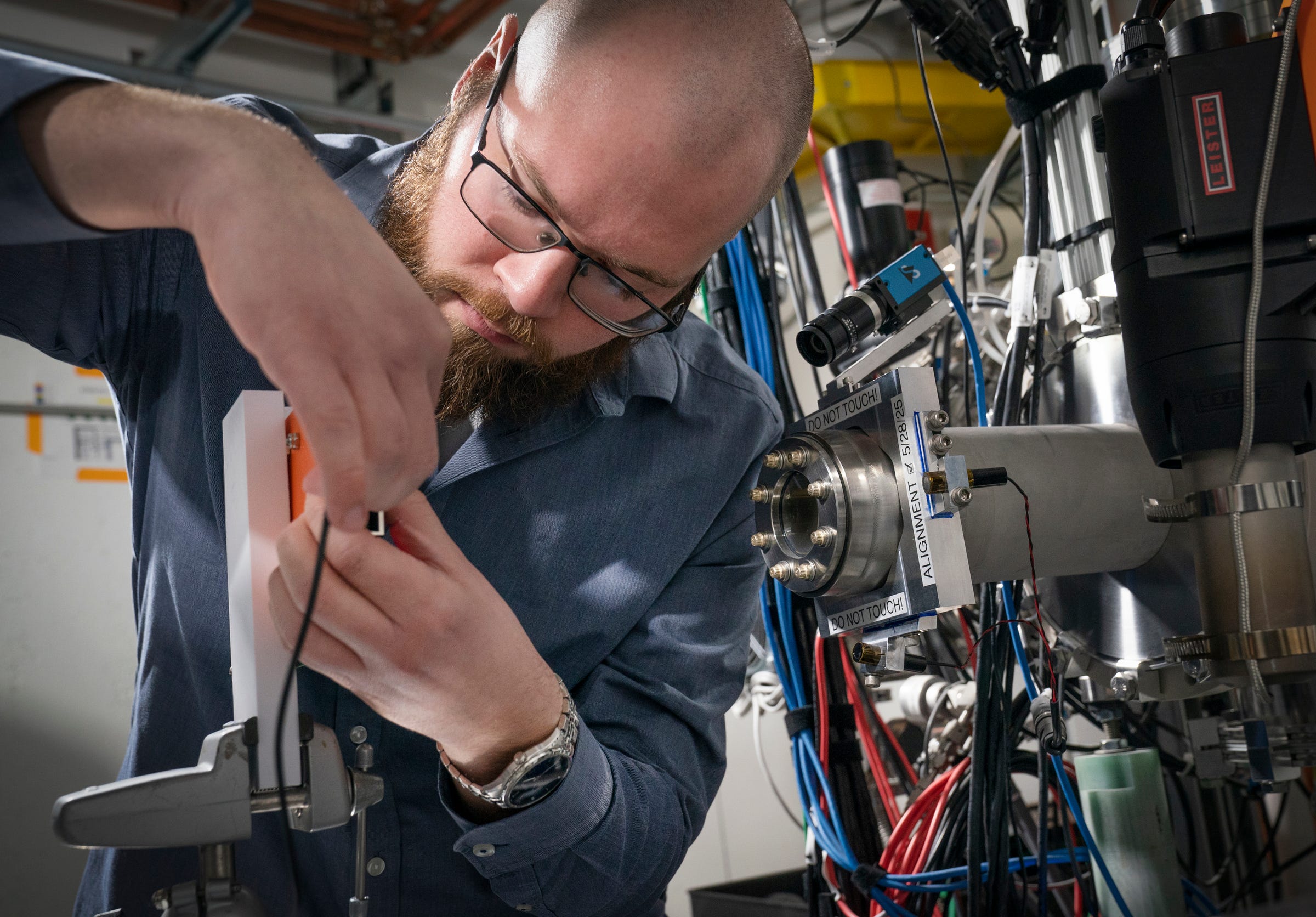
Michigan State University (MSU) has inaugurated a state-of-the-art facility designed for testing microelectronics against cosmic rays, a significant advancement in space technology. The new K500 Chip Testing Facility, which opened in February 2023, was established with an investment of $14 million from the U.S. Department of Defense. This facility simulates years of cosmic ray exposure in just minutes, enabling microchip manufacturers to assess the resilience of their products for applications in space, defense, and automotive sectors.
The facility is one of only three heavy ion cyclotron testing facilities in the United States, alongside those at the Lawrence Berkeley National Laboratory in California and Texas A&M University. The upgraded K500 facility repurposes a superconducting cyclotron originally constructed in 1982 for high-energy nuclear research, now tailored for semiconductor testing.
Thomas Glasmacher, the laboratory director at MSU’s Facility for Rare Isotope Beams (FRIB), emphasized the importance of this facility for modern technology, stating, “The 6G cell phone is all going to be satellite-based; a lot of satellite data centers are going into space. So these chips need to withstand the cosmic rays that hit them all the time.”
Cosmic rays, comprised mostly of high-energy protons and atomic nuclei, originate from various cosmic events, including solar activity and supernova explosions. While most cosmic rays are deflected by Earth’s magnetic field, those that penetrate can disrupt electronic systems, leading to malfunctions. A notable incident occurred in October 2025, when an Airbus A320 operated by JetBlue experienced a sudden altitude drop, injuring 15 passengers. Investigators found that a cosmic ray had interfered with the aircraft’s flight control systems, prompting Airbus to ground 6,000 aircraft for software updates, significantly affecting holiday travel.
As technology advances, the potential for cosmic ray interference grows, making testing facilities like MSU’s essential. Glasmacher explained the facility’s capabilities: “You need to provide the kinds of cosmic rays a device or a chip in space sees in 50 years or so, in a limited amount of time.” The K500 can replicate decades of cosmic ray exposure in as little as five minutes.
The facility operates using a plasma charged with ions, which are accelerated to energies ranging from 20 million to 40 million electron volts before being directed at the test samples. According to Steve Lidia, manager of FRIB’s beam instrumentation and measurement department, the facility offers a customizable testing approach: “We give customers a menu, and they order off the menu. We can produce many different types of beams.”
Since its opening, the K500 Chip Testing Facility has been operating at approximately 40% capacity, with plans to expand its capabilities. The facility aims to provide around 2,500 hours of “beam time” to clients this year, with a new 5,500-square-foot addition planned to accommodate more simultaneous testing activities.
Beyond its industrial applications, the facility serves an educational purpose for MSU students. John Papapolymerou, interim dean of MSU’s College of Engineering, highlighted its role in workforce development: “This facility gives us more opportunity… They get collaboration with industry, they can work on advancing that technology.”
The K500 facility’s initiatives will align with the upcoming Leinweber Center for Engineering and Digital Innovation, scheduled to open in August 2028. This 265,000-square-foot center will focus on various fields, including data science and space electronics, further enhancing educational and research opportunities.
Glasmacher believes the K500 will become a national hub for training students in designing and testing advanced systems for space applications. As technology continues to evolve, facilities like MSU’s will play a crucial role in ensuring that the electronics of tomorrow can withstand the challenges of cosmic rays and other environmental factors.
For further information, contact Keith Matheny at [email protected].

Philadelphia Parks Launch Free Earth Month Events Starting April 1

Bradford’s Fish Fry Fridays Serve Community with Delicious Dinners

Trump Faces Growing Challenges Amid Rising Tensions with Iran

Scientists Probe the Universe’s Missing Topological Defects

Samsung Galaxy Watch 9 to Feature Larger 435mAh Battery

UConn Huskies Aim to Defend Title in 2026 NCAA Women’s Tournament

U.S. Littoral Combat Ships Dock in Malaysia Amid Regional Tensions

Healthy Choice Wellness Reports Quarterly Earnings, Shares Rise

Urgent News: Charles M. Payment Passes Away at 78 in Duluth

University of Hawaiʻi Joins $25.6M AI Project to Enhance Disaster Monitoring

Major Grant Enhances Cancer Care and Research in Hawaiʻi

Joleen Chaney, Beloved Journalist, Passes Leaving Lasting Legacy

San Francisco’s SFO to Welcome 16 Airlines with Nonstop Flights to Europe in 2026

Goldman Sachs Unveils 2026 Catalyst Playbook for Biotech Investors

Discover Top Business Smartphones for Professionals in 2026

Urgent Update: Tom Aspinall’s Vision Deteriorates After UFC 321

Texas Roadhouse Honors Veterans with Free Meal Vouchers

CD Projekt Red Confirms No Release for The Witcher 4 in 2026
-
Science9 months ago
University of Hawaiʻi Joins $25.6M AI Project to Enhance Disaster Monitoring
-
 Health8 months ago
Major Grant Enhances Cancer Care and Research in Hawaiʻi
-
 Top Stories9 months ago
Joleen Chaney, Beloved Journalist, Passes Leaving Lasting Legacy
-
 World7 months ago
San Francisco’s SFO to Welcome 16 Airlines with Nonstop Flights to Europe in 2026
-
 Business8 months ago
Goldman Sachs Unveils 2026 Catalyst Playbook for Biotech Investors
-
 Business7 months ago
Discover Top Business Smartphones for Professionals in 2026
-
 Top Stories9 months ago
Urgent Update: Tom Aspinall’s Vision Deteriorates After UFC 321
-
 Lifestyle9 months ago
Texas Roadhouse Honors Veterans with Free Meal Vouchers
-
 Entertainment8 months ago
CD Projekt Red Confirms No Release for The Witcher 4 in 2026
-

 Top Stories10 months ago
AI Disruption: AWS Faces Threat as Startups Shift Cloud Focus
-

 Health10 months ago
MIT Scientists Uncover Surprising Genomic Loops During Cell Division
-

 Entertainment10 months ago
Discover the Full Map of Pokémon Legends: Z-A’s Lumiose City