
Science
Scientists Assess Risks from Interstellar Objects Like 3I/ATLAS

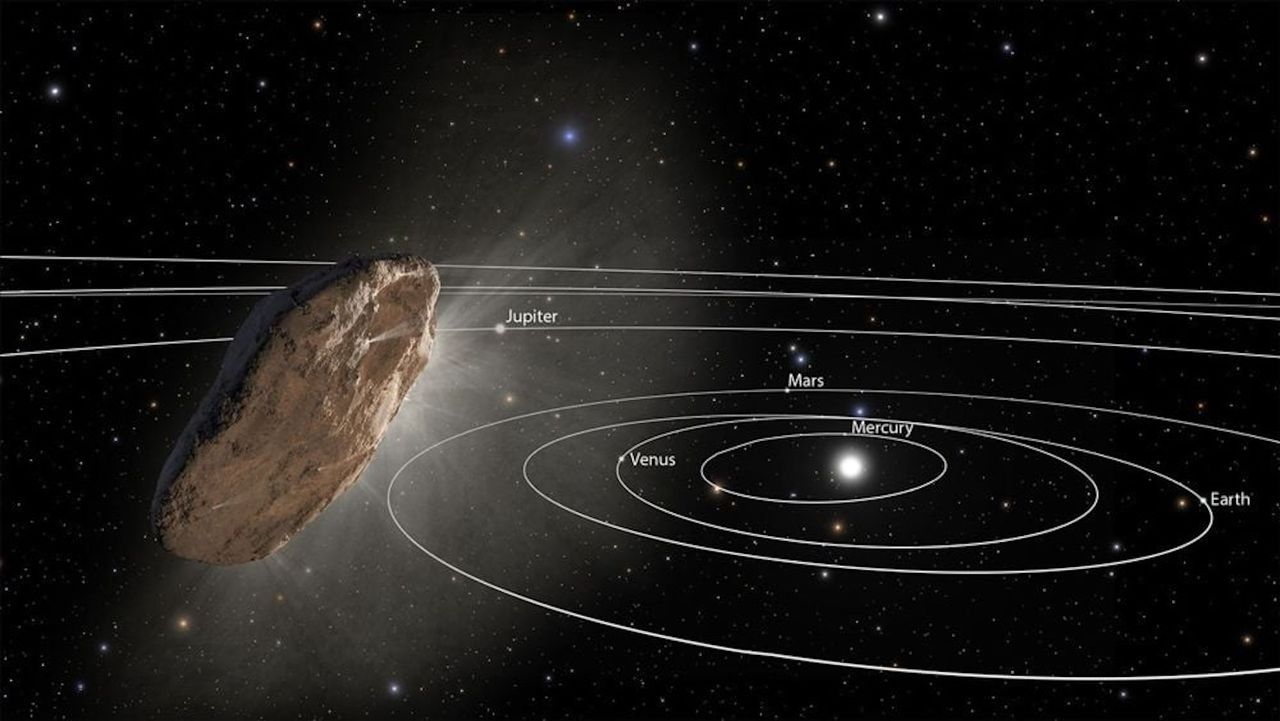
Research into the potential dangers posed by interstellar objects (ISOs) has gained momentum as the comet 3I/ATLAS makes its way through the inner solar system. This comet is the latest addition to a small group of known ISOs, which includes Oumuamua, the first recorded ISO that passed through in 2017, and 2I/Borisov, an interstellar comet that appeared in 2019. Scientists are now examining the impact risks these celestial visitors may pose to Earth.
Over the course of its 4.6 billion-year history, the solar system has likely encountered a vast number of ISOs. Some of these objects may have collided with Earth, potentially contributing to the formation of ancient impact craters, such as the Vredefort impact structure. Today, while the solar system is considerably more stable than in its formative years, the influx of ISOs has not diminished. This raises important questions about the potential risks they pose.
Research published in a paper titled “The Distribution of Earth-Impacting Interstellar Objects,” led by Darryl Seligman, an assistant professor in the Physics and Astronomy Department at Michigan State University, aims to quantify this risk. The study focuses on the expected orbital characteristics of ISOs that might impact Earth, although it does not attempt to calculate their numbers due to a lack of constraints.
The researchers specifically examined ISOs ejected from M-dwarf systems, or red dwarfs, which are the most common type of star in the Milky Way. The authors acknowledge that their focus on M-star kinematics is somewhat arbitrary, given the limited understanding of ISO trajectories. To gain insight, they simulated a synthetic population of approximately 10 billion ISOs to estimate around 10,000 Earth-impacting objects.
The simulations indicate that ISOs are more likely to approach Earth from two primary directions: the solar apex and the galactic plane. The solar apex represents the path the Sun takes through the Milky Way, while the galactic plane is the dense, flat region where most stars reside. The simulations reveal that ISOs from these directions have higher velocities, although those with the potential to impact Earth tend to be slower. This is due to their low-eccentricity hyperbolic orbits, which allow the Sun’s gravity to capture these objects more effectively.
The time of year also affects the likelihood of ISO impacts. The study found that the highest impact velocities occur in spring when Earth moves toward the solar apex. Conversely, winter experiences a greater frequency of potential impacts, as Earth positions itself toward the solar antapex.
Geographically, the research indicates that low latitudes near the equator face the highest risk of ISO impacts. Additionally, there is a slightly elevated risk in the northern hemisphere, where nearly 90% of the global population resides. The authors emphasize that their findings apply specifically to ISOs with M-star kinematics, but the general trends may extend to other types of kinematics as well.
Importantly, the study does not make definitive predictions regarding the number of ISOs that may impact Earth, as such calculations are currently impossible. The authors state, “In this paper we intentionally do not make any definitive predictions about the rates of interstellar impactors.”
The implications of this research are significant for future astronomical observations. Data collected by the Vera Rubin Observatory and its Legacy Survey of Space and Time will contribute to understanding the distribution of ISOs, potentially validating or challenging the findings of this study.
As our awareness of ISOs expands, research like Seligman’s offers valuable insights into their trajectories, timings, and impact locations. The scientific community is eager to gather more data to refine these models and improve our understanding of interstellar risks.

Philadelphia Parks Launch Free Earth Month Events Starting April 1

Bradford’s Fish Fry Fridays Serve Community with Delicious Dinners

Trump Faces Growing Challenges Amid Rising Tensions with Iran

Scientists Probe the Universe’s Missing Topological Defects

Samsung Galaxy Watch 9 to Feature Larger 435mAh Battery

UConn Huskies Aim to Defend Title in 2026 NCAA Women’s Tournament

U.S. Littoral Combat Ships Dock in Malaysia Amid Regional Tensions

Healthy Choice Wellness Reports Quarterly Earnings, Shares Rise

Urgent News: Charles M. Payment Passes Away at 78 in Duluth

University of Hawaiʻi Joins $25.6M AI Project to Enhance Disaster Monitoring

Major Grant Enhances Cancer Care and Research in Hawaiʻi

Joleen Chaney, Beloved Journalist, Passes Leaving Lasting Legacy

San Francisco’s SFO to Welcome 16 Airlines with Nonstop Flights to Europe in 2026

Goldman Sachs Unveils 2026 Catalyst Playbook for Biotech Investors

Discover Top Business Smartphones for Professionals in 2026

Urgent Update: Tom Aspinall’s Vision Deteriorates After UFC 321

Texas Roadhouse Honors Veterans with Free Meal Vouchers

CD Projekt Red Confirms No Release for The Witcher 4 in 2026
-
Science9 months ago
University of Hawaiʻi Joins $25.6M AI Project to Enhance Disaster Monitoring
-
 Health8 months ago
Major Grant Enhances Cancer Care and Research in Hawaiʻi
-
 Top Stories9 months ago
Joleen Chaney, Beloved Journalist, Passes Leaving Lasting Legacy
-
 World7 months ago
San Francisco’s SFO to Welcome 16 Airlines with Nonstop Flights to Europe in 2026
-
 Business8 months ago
Goldman Sachs Unveils 2026 Catalyst Playbook for Biotech Investors
-
 Business7 months ago
Discover Top Business Smartphones for Professionals in 2026
-
 Top Stories9 months ago
Urgent Update: Tom Aspinall’s Vision Deteriorates After UFC 321
-
 Lifestyle9 months ago
Texas Roadhouse Honors Veterans with Free Meal Vouchers
-
 Entertainment8 months ago
CD Projekt Red Confirms No Release for The Witcher 4 in 2026
-

 Top Stories10 months ago
AI Disruption: AWS Faces Threat as Startups Shift Cloud Focus
-

 Health10 months ago
MIT Scientists Uncover Surprising Genomic Loops During Cell Division
-

 Entertainment10 months ago
Discover the Full Map of Pokémon Legends: Z-A’s Lumiose City